0
0
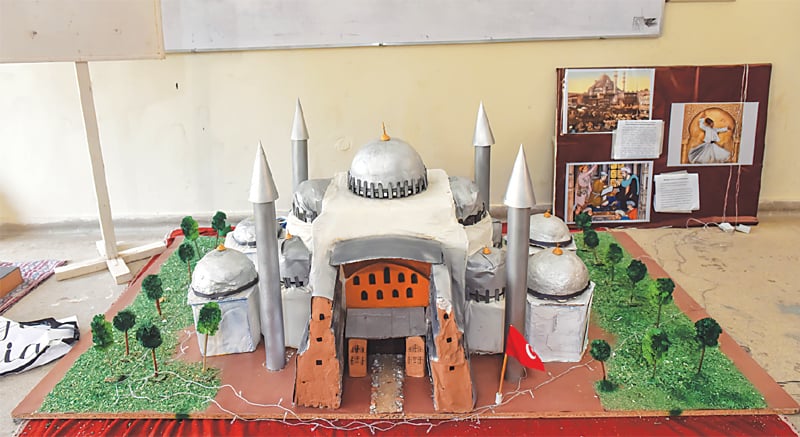
KARACHI: It’s so heartening to see students of the department of history, University of Karachi, put together an exhibition of models and replicas of great works of architecture, paintings and visual depictions of watershed events that took place in the course of history to give the viewer a sense of how deeply they’ve been studying and researching their subject.
The show has been arranged in three spaces: two classrooms and the audiovisual hall of the department. All of them contain models –– produced with materials such as plaster of Paris, cardboard and plastic –– delineating the various phases of man’s progress as the harbinger of change.
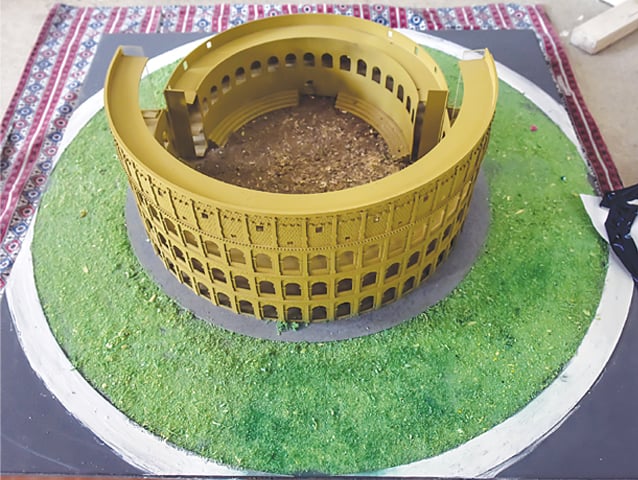
For example, in one room models of Hagia Sophia and the Colosseum are placed side by side. You ask any of the students, and they’re well prepared to tell you about their historical significance. “Hagia Sophia was first a church which was later turned into a mosque by Sultan Ahmed (an Ottoman) ruler. It remained a mosque for a long time. Now it serves as a museum [in Turkey],” says Rida, a second-year student.
KU students make replicas of classical structures
The Colosseum, which first-year students have come up with, stands next to Hagia Sophia. The intention is to show how far societies have come from the Greco-Roman period to the Renaissance to the modern age.
Perhaps the most interesting items are placed in the audio-visual room. Here’s why: there’s a little description of Machiavelli about his views on political science and in one corner rests his small clay sculpture. It is a pretty intriguing work of art made by students Mashal Madani and Hareem Farooq. In the same room, in the space next to the entrance door, there’s a large model of Hiroshima. What’s being shown in the model underlines the destruction that Japan faced at the time when an atom bomb was dropped on the country, and then later, when by sheer perseverance, hard work and steely resolve, it became, and still is, one of the formidable economic powers of the world. To boot, this was eloquently explained to this writer by a final-year pupil, Jibran. The young man argued that Pakistan had not suffered anything similar to Japan, so why can’t we become an economic powerhouse. What a pertinent question.
The third-year students have worked on the Fort of Chittor in India. This meant that the four classes, beginning from first-year students, had worked on the following subjects: ancient civilisation, Muslim empire and European history, ancient and medieval history of South Asia and Europe, and nuclearisation –– destruction and development.
The four-day exhibition concludes today (Oct 26).
Published in Dawn, October 26th, 2018
Download the new Dawn mobile app here: