IN a year when a global reckoning of sexual violence has taken centre stage, two brave activists — a young Iraqi-Yazidi woman forced into slavery by the militant Islamic State group in 2014, and a Congolese gynaecological surgeon — were jointly awarded the Nobel Peace Prize for fighting to end the use of rape as a weapon of war.
This award not only celebrates the extraordinary courage and relentless campaigning of Nadia Murad and Dr Denis Mukwege but also casts a spotlight on two global regions — Iraq and the Democratic Republic of Congo — where women have paid the price for years of armed conflict and terrorism.
Known to put his own security at risk after criticising the government for perpetuating sexual violence, Dr Mukwege administers the Panzi hospital in Bukavu in DRC where he has treated thousands of rape victims in the country’s recurrent civil conflict — a country once called the rape capital of the world. To date, his hospital has helped more than 40,000 rape victims.
Read: Nadia Murad — from IS slave to Nobel laureate
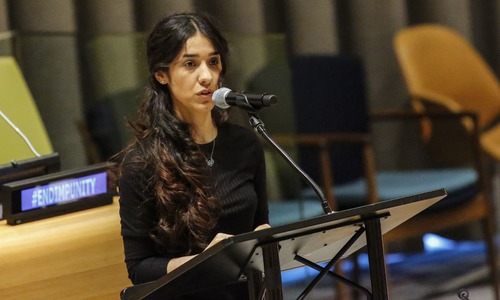
The second youngest laureate, 25-year-old Ms Murad, the voice and face of rape victims, was sold as a sex slave herself, and repeatedly raped when her home in Sinjar in northern Iraq was overrun by IS men.
Such is her courage she asked to be named and photographed when recording her testimony on global platforms revisiting her torture, repeatedly and in public, so she could draw the world’s attention to the enslaved Yazidis. Calling for action against impunity for perpetrators, she has suggested collecting and preserving evidence that could bring IS militants to trial.
It is time, therefore, the world treated sexual violence in conflict as a war crime; not as the unfortunate collateral damage of war.
And a solution is urgently sought for the lack of reparation for women victims in most countries. Since the 1994 Rwandan genocide when around 250,000 women were raped, women have suffered devastating forms of sexual violence in Liberia, Sierra Leone, Darfur and Bosnia among other conflict zones.
Recently, the killing of Rohingya babies and girls, the gang-raping of women and displacement of entire villages has shown that irreparable wartime horrors against minority ethnic communities will continue when authoritarian rulers act with impunity.
This is precisely why the world community must lend humanitarian and legal support to survivors. Ms Murad’s rare resilience to keep telling her story because she wants to ensure she is “the last girl in the world with a story like mine” should be enough inspiration for global leaders to act.
Published in Dawn, October 8th, 2018