0
0
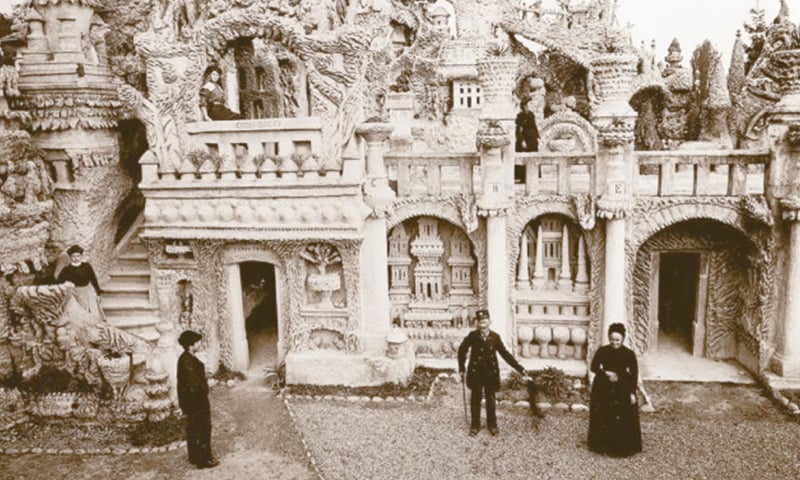

EVEN for a French citizen the expression “Palais du Facteur Cheval” is a bit confusing. Translated literally it could become “Horse Factor Palace”. Things still remain foggy when you apply the other meaning of the word facteur as a postman.
But then there is an explanation … and what a story!
Born in 1836, Joseph Ferdinand Cheval started working at age 31 as postman in the town of Hauterives in the French Alps. Every day, six days a week, he would carry letters walking up and down the mountain trails to homes, normally using a backpack but often also pushing a cart when he had heavy parcels to deliver.
Then, one day, he had a miraculous experience that nobody else can describe better than himself, for Cheval was also a sensitive writer as his detailed and eloquent diary proves:
“Moving in the valley I stumbled upon a hard object and fell down. I noticed a heap of strangely shaped, shiny stones. I scattered them a bit with my mountain boot and soon discovered an unlimited quantity of grey rocks radiant as silver. I put a few of these in my pockets and moved ahead with my work. The same night I had a dream that I was building a palace with my own hands using these stones. I told no one about it for fear of being ridiculed. The next day, I went back to the same place and found other stones, some even more beautiful than the ones I had collected earlier. I gathered many many more, this time using my wheelbarrow. I later found out they were sandstones sharpened by a speeding mountain river and hardened with the passing of time. I thought: since Nature had already done its part of the job, it’s now for me to take care of masonry and architecture to build the palace.”
For the next thirty-three years Cheval continued picking up stones during his everyday rounds to deliver letters and bringing them to build the structure of his own imagination. Half of his time was spent on the outer walls about thirty metres around and the other half creating the inside details.
The postman’s wild imagination would help him erect at the same time an Egyptian monument, a Hindu temple and a residence of Arab architecture, not to speak of sculptures of historical figures such as Julius Caesar, Vercingetorix and Archimedes.
Another side of the palace is devoted to Nature and one can see here statues of elephants, bears, pelicans and many other birds.
Cheval’s monumental adventure would use, of course his laboriously brought-in stones but also a vast amount of cement and lime for which he was paying from his own pocket. When curious visitors started coming from the nearby towns by 1905, he had an idea. He placed a box requesting them to drop in coins to help him continue with his work.
In his own words: “The visitors’ generous contributions finally allowed me to buy 15,000 packs of lime and cement.”
The postman’s reverie would fully materialise by1923 and he would die peacefully a year later.
Artists and intellectuals were always attracted by Cheval’s creation, including painters like Pablo Picasso and Max Ernst and writers such as André Breton and Anaïs Nin, but curiously in his own country he was always considered an eccentric who had wasted his life on a useless, naïf effort.
It would take the French Minister of Culture André Malraux, an intellectual and author of many books in his own right, a number of years to finally have the “Postman’s Palace” officially declared in 1969 as a national monument.
Today some 200 thousand visitors arrive at the site annually and next year a film is coming out based on the life and work of Joseph Ferdinand Cheval.
The writer is a journalist based in Paris.
Published in Dawn, September 3rd, 2018