The Foreign Office needs serious, full-time and empowered political leadership — a reality that PML-N supremo Nawaz Sharif ignored for a full parliamentary term between 2013 and 2018.
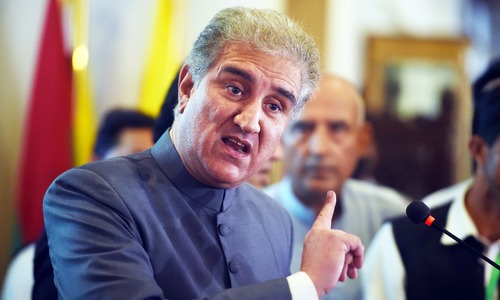
So, it is welcome that the new PTI foreign minister, Shah Mehmood Qureshi, has immediately faced the media and attempted to give the country and the outside world an indication of the PTI government’s approach to and priorities in the foreign policy domain.
“Let me be clear: the foreign policy will be made here, at the Foreign Office of Pakistan,” Mr Qureshi has commendably stated. He also indicated his preferred approach to healing the civil-military divide: “I will engage with all the institutions for the betterment of the country. It is the policy across the world. Feedback is sought from national security institutions.”
Taken together, Mr Qureshi’s comments suggest that the PTI will indeed seek to increase the space civilians have in the foreign policy and national security domains and that it will do so by engaging in an inter-institutional dialogue.
If the PTI is to succeed in crafting a civilian-led foreign policy, Mr Qureshi and his boss, Prime Minister Imran Khan, will also have to develop a coherent strategic vision. All newly installed governments have talked of dialogue, good neighbourly relations and a focus on trade. But the strategic environment that Pakistan must contend with is fraught with risk and needs careful management.
Even in a relationship as seemingly rock solid and on a path to greater strategic convergences than ever as with China, there are serious financial issues in CPEC projects that will have to be resolved.
Mr Qureshi’s claim that his government’s new foreign policy will “begin and end at Pakistan” — seemingly a version of US President Donald Trump’s ‘America first’ policy — will be quickly tested by both friend and rival.
India, Afghanistan and the US are perennial challenges for Pakistan to deal with and the PTI ought to be prepared for bruising discussions on an array of issues. The PTI government could benefit from Mr Qureshi’s tenure as PPP foreign minister in that regard.
Perhaps what the PTI’s foreign policy team should keep in mind is that much will depend on how engaged Prime Minister Khan remains and the overall state of the civil-military relationship. Mr Khan’s politics has long revolved around a mostly, arguably wholly, domestic agenda. A victory speech the day after the general election was widely welcomed perhaps because for the first time Mr Khan had spoken in some detail about his foreign policy vision.
So if Mr Qureshi is to have a successful term as foreign minister, he will need the regular engagement of his boss, the prime minister, particularly when it comes to forging an inter-institutional consensus on key foreign policy and national security issues. It will be difficult, but it is possible.
Published in Dawn, August 22nd, 2018