Social media giant Facebook on Saturday restored for Pakistan users an October 2017 post by Dawn.com that it had blocked a day earlier for allegedly violating local laws.
"Due to legal restrictions in your country, we've limited access to your post on Facebook," the platform had shared in an automated message on the evening of Friday, May 11.
The post in question had linked to a story on veteran politician Javed Hashmi criticising the judiciary.
The post was restored on Saturday evening, with Facebook apologising for the content being "incorrectly restricted."
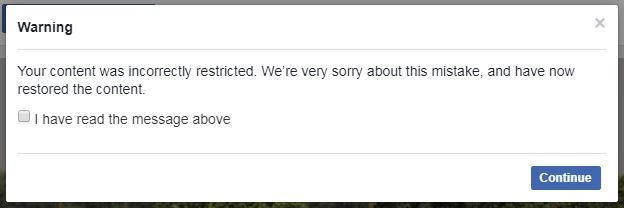
"Your content was incorrectly restricted. We're very sorry about this mistake, and have now restored the content," an automated message shared by the social media giant said.
The company had earlier said that it had made the content unavailable "based on local law" — an action that is usually taken after requests from state institutions under non-transparent agreements, a fact that media and human rights organisations have criticised in the past.
Facebook had not stated what law the Dawn.com post had violated, nor had it specified where the request had originated from.

Under fire for privacy concerns, hate speech and its role in 'influencing' the American elections, censorship under directions by governments is nothing new for Facebook.
The platform, with over 1.9 billion users across the globe, has controversially restricted access to content.
For example, the website's censorship policies had in the past led to many user accounts being blocked or deleted in 2016 for posts criticising India following the killing of Kashmir’s young ‘freedom fighter’, Burhan Wani.
Under increasing pressure
According to a transparency report issued by Facebook, the Pakistani government sent 1,050 requests for data to Facebook between January and June 2017, compared to only 719 during the same period in the preceding year.
It also said that 177 pieces of content were restricted from viewership in the country on requests forwarded by the Pakistan Telecommunication Authority (PTA) and the Federal Investigation Agency (FIA) for violating "local laws prohibiting blasphemy and condemnation of the country's independence".
Facebook had also found itself directly in the line of fire last year when an Islamabad High Court (IHC) judge, Justice Shaukat Aziz Siddiqui, and then interior minister Chaudhry Nisar had threatened to completely ban the social network if it did not act to remove all blasphemous content on its platform.
Why block the post?
However, Facebook's restriction of access to Dawn.com's post for Pakistani users did not seem to have been triggered by concerns over blasphemy.
The story it was linked to dealt instead with an emergent theme in Pakistan's politics: judicial activism.
Read the article: 'Pakistan has never seen a crisis worse than the one it is in today': Javed Hashmi
As criticism of what some see as an 'overactive judiciary' heats up, the higher courts have started taking up more high-profile contempt cases than ever.
One former senator, Nehal Hashmi, was recently handed a prison term after being found to have violated prevalent contempt laws. Likewise, a man in Multan was earlier this month handed an 18-year prison sentence for throwing a shoe at a judge.
Meanwhile, television channels have been told to tune out politicians' speeches if they veer towards 'contempt' of the judiciary, and the broadcast media regulator has found itself in the cross hairs of the higher courts for not doing enough.
Reproduced below is the complete article whose Facebook post had been blocked from viewership in Pakistan
'Pakistan has never seen a crisis worse than the one it is in today': Javed Hashmi
Never in the country's history has Pakistan faced a worse crisis than the one it faces today, former PML-N leader Javed Hashmi said in a characteristically well-timed press conference on Monday.
The press conference was called by him to share insights on Pakistan's political and constitutional struggles, his own struggles for democracy and his brief stint with the Pakistan Tehreek-i-Insaf (PTI).
"This is a land that works without a constitution," Hashmi said at the start of the presser hosted in Islamabad.
Criticising the manner in which the 1956 and 1973 constitutions were formulated, he said the "civil and military powers alter the constitution at will". He added that Zulfiqar Ali Bhutto ran the country into a state of emergency.
"Then came Ziaul Haq, who himself was the constitution," he said.
"We could not become a nation which respects its constitution," he said, claiming that the country has never seen a worse crisis in its 70-year history than the one it sees today.
'Supreme Court caused more destruction than anybody else'
Talking about the role of the Supreme Court, Hashmi said: "The Supreme Court has caused more destruction in the country than any other institution."
He alleged that the court had allowed former president and military dictator Pervez Musharraf to change the constitution, although he had "broken" the Constitution twice.
However, he clarified that he was not criticising incumbent Supreme Court justices. "I know that if I say anything about the current SC, it will amount to contempt of court," he noted.
"The current chief justice [of Pakistan] publicly kissed my hand, how can I say something against him?" Hashmi asked.
He said many SC judges swore to get plots but again clarified that he was not talking about the current judges, who he said, were saints.
'Did not want to end Imran's politics'
Revealing more details of him quitting PTI two years ago, Hashmi said his decision to resign was a "suicide attack" on Imran's party.
"Had I not resigned, it would have been the last day of the parliament," he said, revealing that the PML-N had also suggested he make a forward bloc within PTI.
"Had I done that, I could have received the prime minister's protocol," he claimed.
He said he refused to make the forward bloc and that he was sure PML-N realises now it would not have been a good move.
"I had the backing of 15 PTI MNAs but I did not want to finish Imran Khan's politics," the veteran politician claimed.
'Army chief did not want nuclear tests in 1998'
Javed Hashmi, who was the minister of health in the second Sharif government, claimed that the then army chief had not wanted Pakistan to conduct its nuclear tests in 1998, adding that Dr Abdul Qadeer Khan — the architect of the country's nuclear programme — was a witness to this.
He also claimed that Musharraf had created the National Accountability Bureau (NAB) to target one political party and that the politicians will have to continue facing the bureau if they failed to create another institution for real accountability.
Hashmi has also previously accused Imran Khan of conspiring with disgruntled elements in the army to bring down the government during PTI's 2014 sit-in against election rigging.