0
0

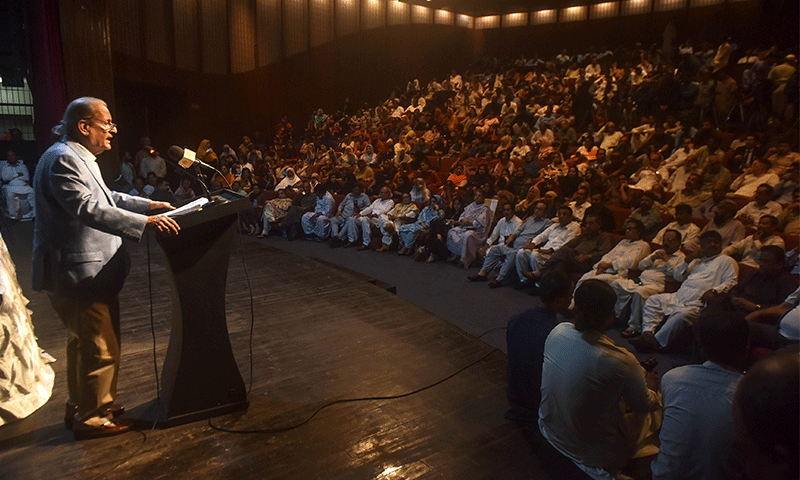
KARACHI, May 20: Experts at a seminar stressed on efforts for making the benefits of information and communication technologies (ICTs) to all, without any discrimination between urban and rural areas of Pakistan. The seminar on “Realizing the full potential of information and communication technologies” organised by Pakistan Press Foundation (PPF) was held on Thursady evening, here at its Vicky Zeitlin Media Library.
Sindh IT Minister Syed Mustafa Kamal gave his keynote address at the seminar in connection with the World Telecommunication Day.
The minister said his department with determination succeeded in creating awareness about information and communication technologies, to maximum number of people in a very short span of time, in Sindh.
“ICT is a matter of survival for us, as it is involved in the development of almost all the sectors, including economy, health, defence, etc,” he added.
Mr Kamal said his department was emphasizing on e-government with the cooperation of private sector, as without its participation, no revolutionary change could be brought about.
“IT progress can play a significant role in resolving, to certain extent, a major problem of unemployment, that Pakistan is faced with.”
Explaining this claim, he said that Pakistan had a favourable and competitive edge in the region of capturing part of the world ICT market of US$200 billion. Pakistan had to properly market its potential in this field. At present, global companies were shifting their business to those areas, where they had low cost and high efficiency of human resource.
“We are not lagging in any way, as compared to other countries, as we have skilful human resource. My department has a success story to tell: that we have started getting results and expect US$50 million investment beside creation of 10,000 jobs in six months.
The minister further informed that we had selected 1,000 unemployed graduates and were providing them, six months training as call centre agents.
PTCL Manager Corporate Customer Centre Rizwan Bhutto said access to basic infrastructure of IT, ability for use and proper application were most important factors.
“We can use underground cable, radio communication and satellite technology in technological features. While deregulation policy should be adopted and foreign investment should be made by offering incentives to investors,” he told.
Mr Bhutto said about 400,000 new jobs would be created in the next five years in the ICT sector and investment would also increase.
“At present, only 1,900 cities and small towns out of 50,588 all over Pakistan, have access to the internet. The PTCL is reducing tariff and subscription charges. Call centre business is also increasing. We have started a tele-medicine project in three hospitals JPMC, Gumbat and Shikarpur, in collaboration with Engro. There is another such project to interconnect all district government hospitals,” he informed.
Executive District Officer, City District Government Karachi, Syed Mushtaq Hussain said that though it was a difficult task, but access was increasing with rapid growth of telecom services, and people were benefiting constantly from declining telephone and internet tariffs.
“Information and communications technologies, through internet, telephones, cellular phones, pagers, fax machines, radio and television broadcasting to satellite communications have developed significantly in Pakistan. Like many other fields we look forward to reduce difference in access to ICTs between the urban and rural areas, the rich and the poor, which we had to overcome for developing an equitable information society,” he stressed.
A recent example of critical importance of ICTs was tsunami disaster, 9/11 incident, Iraq war, which was brought home to us in a manner unimaginable earlier, he told.
Chairman MIS and Computer Department, Institute of Business Administration, Dr Sayeed Ghani said only 10 per cent of world population was using internet and it remained an important factor in the growth of ICT sector.
“Utilization of a facility in positive development is also important and parents should educate their children in this regard,” he emphasized.
Mr Ghani cited the example of India, where ICT was being used in different fields like tele-medicine, e-banking, e-agriculture, etc.
Earlier, PPF Director Mrs Samina Ishaque highlighted the importance of this technology in growth of the economy of any country.
She said the seminar was organized in connection with the World Telecommunication Day, with the theme “Creating an equitable information society: Time for action.”—PPI