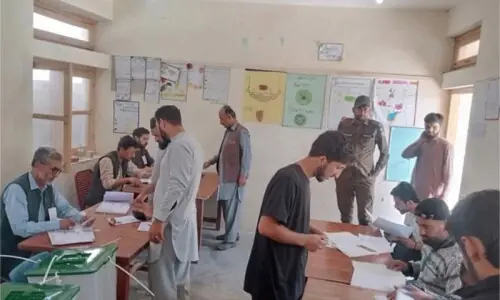
IT appears that the PPP is in a comfortable position to form the government in Gilgit-Baltistan after Sunday’s polls for the region’s assembly.
Though the party was leading the unofficial count at the time of writing, the polling process was not without controversy, with the PPP itself claiming there had been irregularities. The PTI also claimed there was “poll rigging”. The local election commission has announced a re-poll on five seats next week.
It is hoped that the complaints about the polling process are satisfactorily addressed so that the elections have legitimacy. Unless there are radical changes to the final tally, the PPP will most likely head the incoming GB government, possibly in a coalition with the PML-N. Deputy Prime Minister Ishaq Dar has already congratulated the PPP on its victory.
The PPP has a strong base in GB, and has formed governments here before. However, the electoral process in the mountain region should not simply resemble a game of political musical chairs. The new administration must address the region’s issues proactively.
Over the past few years, the region has been rocked by a series of protests over issues as varied as wheat subsidy, prolonged power breakdowns and questions about taxation. At the core of all these protests is a sense of alienation the local people feel from the present political formula, with the local assembly seen to be lacking power and all the decisions that matter being taken in Islamabad.
The incoming cabinet must work hard to change these perceptions. While questions about GB’s constitutional relationship with Pakistan — particularly the possibility of it becoming a provisional province pending the resolution of the Kashmir dispute — are hardly simple, local political forces do not necessarily need intricate legal changes to deliver good governance.
They simply need to listen to the electorate, and do their best to deliver the people’s requirements. If the people’s needs are not addressed through the electoral process, they may return to the streets.
The old brand of politics is unlikely to work in GB. Many of the region’s voters are young and educated, and are unlikely to be swayed by the politics of patronage and ‘influentials’. They want a resolution of their legitimate demands. This includes the provision of fundamental rights, first right over the region’s resources, and a voice regarding its future. Surely, these are not impossible demands.
The federal authorities, along with the newly elected regional government, need to assure the people of GB that they are aware of their grievances and demands and will do whatever is possible to resolve the region’s constitutional and civic issues.
Simply making promises is not enough. GB’s voters want to see action, not just words. The incoming government, therefore, will have its hands full.
Published in Dawn, June 11th, 2026