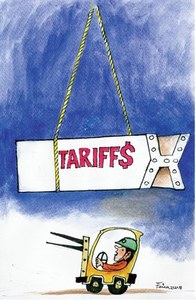
As US-China trade tensions ratchet up, the technology sector is fretting over the potential for collateral damage to one of America's most important export industries.
The tech industry is not directly affected by the new tariffs unveiled by the Trump administration which aim to target Beijing for unfair trade practices failure to protect intellectual property.
But some industry leaders fear tech will be dragged into the dispute, with the potential to impact the estimated $3 trillion industry in which the US and China are key players.
"As trade wars escalate, they are not controllable, they are not predictable," said Ed Black, president and chief executive of the Computer & Communications Industry Association, which represents major tech firms such as Amazon, Facebook, Google and Netflix.
"There is always collateral damage."
Black said the US administration "correctly identified some of the problems" with trade involving China but "missed all the problems of internet companies doing business in China."
Black said the tech industry understands the need to confront China over trade barriers and other practices, but that Washington's efforts to go alone could "weaken the international trading system."
The relationship of US tech firms with China has long been complicated by concerns about censorship, labor and human rights and the potential for stealing trade secrets.
Google shut down its search engine for China in 2010 after it found accounts of Chinese human rights activists hacked and some US-based online platforms are banned by Beijing.
But Apple recently agreed to base its cloud storage for Chinese users in the country, saying it had to comply despite concerns over Beijing's surveillance of citizens. And Airbnb said it would share customer data with the Chinese government as well.
Data as fuel
Susan Aaronson, a George Washington University professor of international affairs who specializes in digital trade, said that as American firms battle for supremacy in artificial intelligence, they are hungry for sources of data, including from China.
"In almost everything the US produces, the key source of value is data," Aaronson said.
She wrote in a recent research paper that China "uses the lure of its large population, relatively low and poorly enforced privacy regulations, and subsidies to encourage foreign companies to carry out AI research in China."
Her paper argued that American trading partners "need to encourage the data flows that power AI while simultaneously protecting citizens from misuse or unethical use of algorithms."
Some analysts say the Trump administration has correctly identified some of Beijing's unfair trade policies but that tariffs may be counterproductive.
"China uses mercantile practices and the Trump administration is right to contest those actions, but there are many reasons the tariff approach is not the right one," said Stephen Ezell, vice president for global innovation policy at the Information Technology and Innovation Foundation, a technology-focused think tank.
With tariffs, he said, "US consumers and businesses will pay more in the long term. We need to take on China but we shouldn't be penalizing ourselves in the process."
Aaronson agreed that China has disadvantaged foreign firms but argued for a multilateral approach involving allies and global institutions "to move China toward more openness and the rule of law."
Secretly applauding?
Tech industry analyst Patrick Moorhead of Moor Insights & Strategy said that some in Silicon Valley "are secretly applauding" the move to shake up trade relations with China after years of frustrations.
"Americans can't own businesses in China, they have to set up a joint venture, which sometimes means you have to share intellectual property," Moorhead said.
"If you sell software, the Chinese government has to bless the source code. For hardware, you have to give very detailed schematic drawings. Some things have changed but some haven't."
Moorhead noted that some Chinese firms such as computer giant Lenovo are expanding in the US, but that American firms are having a harder time in China.
Still, Moorhead said he sees trade frictions increasing with some negative effects in the short run.
"I see (tariff actions) moving to electronics and I see it tit-for-tat until it starts to get painful," he said.
"I could see a tariffs on (US imports of) iPhones, and China could put tariffs on components going into the iPhone. I think it's going to get worse before it gets better."