18
18

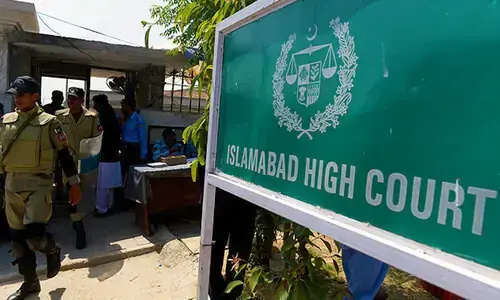
The Lahore High Court (LHC) on Thursday ordered government authorities to not "harass" banned Jamaatud Dawa's (JuD) Chief Hafiz Saeed and allow him to continue his social welfare activities until April 23, the date of the next hearing.
Justice Ameenud Din Khan, who heard the petition filed by A.K. Dogar on Saeed's behalf, also directed the authorities to submit their responses on the JuD leader's petition by April 23.
Saeed alleged in his petition that the government was interfering in his party's welfare projects because it had bowed down to pressure from India and the United States.
The petition argues that barring an organisation or party from indulging in charity work goes against the Constitution.
Dogar, who was representing Saeed today, urged that since the case was of a "sensitive nature", the court should form a full bench. Justice Khan responded that the decision to constitute a full bench will be made in the next hearing.
Saeed had filed a nearly identical petition through Dogar before the same judge last month. Justice Khan had directed the federal and provincial governments to submit their responses by April 27.
However, due to the similar nature of both petitions, the court decided to club the cases.
After hearing Saeed's arguments in today's hearing, Justice Khan issued notices to the federal and provincial governments again, directing them to file their replies. The hearing was subsequently adjourned until April 23.
Banned organisations
On January 1, the Securities and Exchange Commission of Pakistan had barred JuD and several other such organisations named in a list of banned outfits by the United Nations Security Council from collecting donations in the country.
The federal government had followed suit on February 12, with President Mamnoon Hussain amending the Anti-Terrorism Act (ATA) 1997 and issuing the amended Anti-Terrorism Ordinance 2018, following which the personnel banned through the UN stood banned in Pakistan as well.
The move had come days before a Financial Action Task Force (FATF) meeting was to take place and where it was feared that Pakistan would be placed on its watchlist of countries where banned militant outfits have allegedly been raising funds.
Despite the preemptive measure of banning the JuD, the Foreign Office (FO) later confirmed in February that Pakistan would still be placed on the FATF watchlist. FO spokesperson had, however, ruled out the possibility of things escalating to Pakistan being blacklisted.