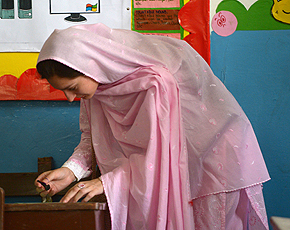
THERE is rising recognition that democracies are incomplete without women’s voices in the electorate.
Where women have a right to vote and stand for office, there have been profound effects on political change in those countries. One of Pakistan’s serious democratic deficits is that even though women constitute half the country’s population of 200m citizens — as the 2017 census indicates — out of 97m registered voters, only 42m are women while about 55m are potential male voters. Disappointingly, this indicates an increase to 12m in the gender electoral gap from 10.97m in 2013.
Some evidence of this was discussed in a report published in this newspaper on Friday on the predicament of women voters in Mianwali, Punjab. Hindered in their attempt to make it to the electoral rolls, most women, including a grandmother from Kalabagh district, did not possess CNICs that serve as voting passports in this country.
Read: How will the women from Mianwali who do not have CNICs vote in the upcoming election?
Bridging the electoral gender gap will be no small feat for the ECP when many women from KP and Punjab lack CNICs which are essential for voter enrolment.
Time is of the essence — an April deadline is looming for prepared electoral rolls. Ongoing emergency registration campaigns in 79 districts countrywide are a well-intentioned effort, though with massive illiteracy and low levels of voter sensitisation only fast-track door-to-door registration can work.
Meanwhile, the reason for missing women voters is also reflective of the ineptitude and lack of foresight of the political parties.
The exercise to encourage women to register with Nadra and then enlist themselves as voters should have started after the last election. To gauge the electoral gender gap, an ECP-led survey in Gujrat, for example, found that 35,000 women voters over 18 do not have CNICs. Surveys in KP and Fata would find a similar situation. Without the support of political parties, barriers to women’s enfranchisement will remain.
This year’s polls must not be a rerun of 2013 when many women were barred from voting because of the collusion of local elders, political parties and non-state actors. It is because political parties have failed to mobilise the female vote bank that many women have had little interaction with or even scarce interest in what politicians offer. Party leaderships should be aware of the value of women voters and tailor campaigns for their participation.
As yet, there appears to be no realisation that women could be potent swing voters if drawn to a particular issue-based political campaign promising to better their lives.
Published in Dawn, March 26th, 2018