Pakistan loses 50pc market share in Kabul



KARACHI: India has succeeded to penetrate in Kabul slashing the market share of Pakistan by more than 50 per cent in the last two years, Chairman Pakistan-Afghanistan Joint Chamber of Commerce and Industry Zubair Motiwala told Dawn on Friday.
Motiwala who recently visited Kabul said the penetration of India and China has limited Pakistan’s option to retain its market share while India subsidises heavily on its exports. He said Pakistan’s trade with Afghanistan fell to $1.2 billion from $2.7bn within in the last two years and the country has been losing even the traditional markets of flour, men and women’s clothes and red meat.
India has been providing goods at subsidised rates to capture the market and are providing air tickets with a 75pc rebate, said Motiwala, adding that Afghans find it easy to travel to India with cheap tickets and free multiple visas without police checks.
Kabul has been the natural market for Pakistani exports but that is changing as cheaper products from China and India flood the country. According to Pakistan Bureau of Statistics, exports to Afghanistan dropped to $1.271bn in FY17 from $1.437bn in FY16. Exports in the first quarter of 2017-18 stood at $319 million.
Each year thousands of Afghans used to visit Peshawar for medical treatment but now they prefer India due to cheaper treatments and other attractions like concessional treatments. “Medical tourism of Peshawar, which was mainly due to Afghans, is now at zero level; hospitals in Hayatabad are empty,” he continued.
He said Peshawar is the main victim of the declining trade with Afghanistan where people have lost their businesses on a large scale. Out of 200 flour mills, about 100 have been closed down due to a drastic fall in the export of flour to Afghanistan, he added.
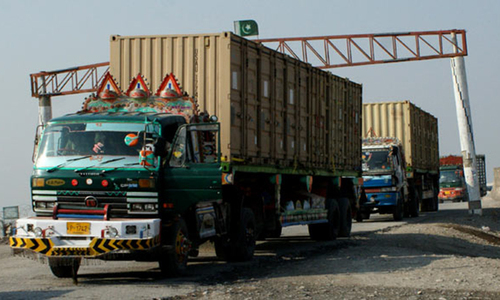
He also referred to the decreasing containers’ traffic from Pakistan to Afghanistan. He said 70,000 goods containers were used to pass through between the two countries which has now dropped to just 7,000, reflecting the change of routes for imported goods to Afghans.
Pakistan was the biggest supplier of shalwar qameez suits to Kabul but that too has changed since both India and China are now supplying the readymade suits which are traditionally Pakistani products.
State Bank’s data showed that the imports from Afghanistan increased to $68m in FY17, compared to $40m in FY16.
Published in Dawn, March 4th, 2018