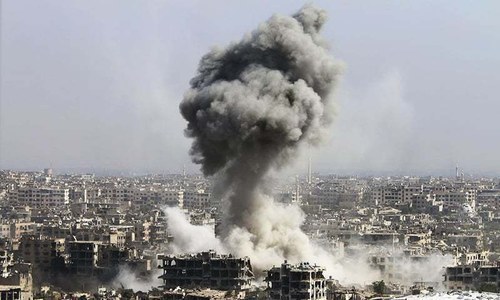
Air strikes and rocket fire hit the Syrian rebel enclave of Eastern Ghouta for a seventh straight day on Saturday after the United Nations (UN) again delayed a vote on a ceasefire.
The Damascus government launched a devastating bombardment of the enclave just outside the capital last Sunday that has now killed at least 474 civilians, according to the Syrian Observatory for Human Rights.
The Britain-based monitor of the war said three civilians were killed and 12 wounded in Russian air strikes on the Eastern Ghouta town of Harasta early on Saturday.
Moscow, which intervened militarily in support of its Damascus ally in 2015, has denied any direct involvement in the Eastern Ghouta bombardment.
The Observatory relies on a network of sources inside Syria and says it determines whose planes carry out raids according to type, location, flight patterns and munitions used.
United States (US) President Donald Trump on Friday said Russia's recent actions in Syria were a “disgrace”.
Friday's civilian death toll in the enclave, under siege by the Syrian army since 2013, totalled 41, including 17 children, according to the Observatory.
The UN Security Council had been due to hold a vote on Friday on a resolution calling for a month-long ceasefire to allow aid deliveries and the evacuation of seriously wounded civilians.
But the vote was postponed until 5pm (GMT) on Saturday as Western powers bickered with Russia over the wording.
Control of Eastern Ghouta is shared between two militant factions and Syria's former Al-Qaeda affiliate, and Russia insists there can be no ceasefire with the terrorists or their allies.
Russia has been pressing for a negotiated withdrawal of rebel fighters and their families like the one that saw the government retake full control of the second city Aleppo in December 2016.
But all three rebel groups have refused.
World leaders have expressed outrage at the plight of civilians in Eastern Ghouta, which UN chief Antonio Guterres called “hell on earth”, but have so far been powerless to halt the bloodshed.
The enclave is completely surrounded by government-controlled territory and its 400,000 residents are unwilling or unable to flee the deadly siege.