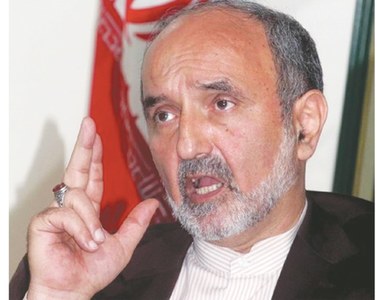
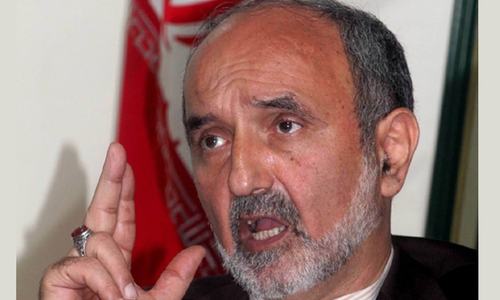
ISLAMABAD: Iran’s envoy to Pakistan Mehdi Honardoost on Thursday regretted that establishment of bilateral banking ties was being delayed because of Islamabad’s ‘conservativeness’, while Iran-Pakistan (IP) gas pipeline project remained frozen.
He was speaking at a seminar at the Strategic Vision Institute (SVI) on “Contemporary Relations between Pakistan, Iran and Saudi Arabia: Present Challenges”.
There were “unjust US sanctions” on Iran, but then “conservativeness of our brothers” was delaying opening of banking channels, even though many countries maintained banking relations with Iran, he said.
The Iranian ambassador’s statement came amid continuing challenges in bilateral ties despite the apparent improvements since Army Chief Gen Qamar Bajwa’s visit to Tehran late last year. Iran leasing out Chabahar port to India and the Pakistan Army announcing deployment of troops in Saudi Arabia are renewing the mistrust between the two neighbours.
Rejects perception that India will use Chabahar port against Pakistan
Banking relations are considered crucial to expanding bilateral trade, which is currently at $1.2 billion. The target is to increase it to $5bn per annum over the next few years, but it looks to be a difficult goal to achieve in the absence of regular banking channels.
The State Bank of Pakistan (SBP) had last April signed a Banking and Payment Arrangement (BPA) with Iran’s central bank, the Bank Markazi Jomhouri Islami Iran (BMJII), for providing a trade settlement mechanism to promote bilateral trade. The central banks of the two countries were to subsequently invite commercial banks to carry out transactions under the BPA. But no progress could be made due to lack of interest on the part of Pakistani banks.
About the IP gas pipeline, Mr Honardoost said there was a consensus that the project was beneficial for Pakistan’s economy, but it was still “frozen” on the Pakistani side due to external and internal factors.
He believed that implementation of the pipeline project would help the two countries surmount some of their common problems, besides paying other economic dividends to them.
The ambassador rejected the impression that India could use Chabahar port against Pakistan. He cited continued sanctions against his country despite the nuclear deal as one of the reasons for leasing out the port.
Speaking on the occasion, Defence Minister Khurram Dastgir Khan said Iran should have better understanding of Pakistan’s historical ties with Saudi Arabia and the Gulf states.
“Our interests in stability in GCC countries stem from the fact that around 1.9 million Pakistanis live in Saudi Arabia alone, who are contributing a great deal to our foreign exchange reserves,” he said.
Mr Khan said the government’s Middle East policy was “undergirded by its longstanding close relations with Saudi Arabia and by the focus on limiting the domestic fallout of sectarian tensions stemming from the Saudi Arabia-Iran rivalry”.
He said that Pakistan had an “ideological affinity and deep military, economic, and leadership” ties with the Saudi kingdom, whereas it was building “economic cooperation and counterterrorism links” with Iran. “An opening” has been achieved with Iran, he added.
Relations with Saudi Arabia, the defence minister said, were being updated and expanded to newer areas, including economic and industrial cooperation.
He said that Pakistan had for decades deputed its troops to Saudi Arabia under bilateral agreements on training and advisory missions. He avoided talking in detail about the latest announcement on deployment of troops in the kingdom and did not take any questions.
The SVI president, Dr Zafar Iqbal Cheema, said the recent decision to send troops to Saudi Arabia highlighted the challenges Pakistan was facing in walking the tightrope in relations with the two countries.
He believed that an announcement with regard to deployment of troops should have been made by the political government instead of the military’s media wing. He also recalled the parliamentary resolution about maintaining neutrality in Middle Eastern conflicts.
Published in Dawn, February 23rd, 2018