Story of Imperial China captivates listeners


 0
0
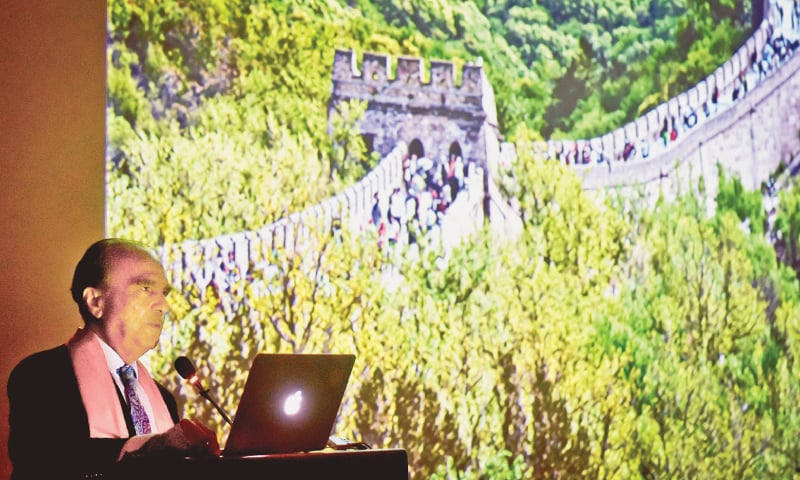
KARACHI: The story of Imperial China through the camera lens of Aga Khan University Hospital ENT surgeon Dr Iftikhar Salahuddin as a part of the 6sf lecture series turned out to be a very appropriate talk on Tuesday, it being the fourth day of the Chinese New Year.
The doctor started from Zhongguo, the Middle Kingdom, which China was known as. The people of the Middle Kingdom were not interested in what was going on in the world around them or the civilisations in the West. They believed they alone were important and that they were surrounded by ignorant barbarians.
To stop foreign interference the Emperor Qin She Huang of China’s first dynasty, the Qin Dynasty, decided to build the Great Wall of China. About the wall, the lecturer added that it was a romantic myth that it can be seen from space or the moon. In fact, it serves as a huge graveyard of the labourers, who happened to be soldiers and criminals brought in to build it.
It is also a fact that the Wall, starting from Jiayuguan in western China’s Gansu province, following the mountains bordering Inner Mongolia and the North China Plain, to the Bohai Gulf at Shanhai Pass, and then looping round the Bohai Gulf to terminate at the Hushan Great Wall section on the North Korean border, was actually completed during the time of the Ming Dynasty.
One of Dr Salahuddin’s photos also showed Pakistan’s contribution to the Great Wall. The Chinese government, too, has acknowledged Pakistan’s help in repairing a portion of the wall in recent times by etching a stone with Pakistan’s name.
More photographs included those of Emperor Qin She Huang’s buried terracotta army discovered by a farmer digging for water during drought. “There are soldiers, chariots, all ready in battle formations there though their original colour has now faded in the sun,” said the doctor. He added that the Chinese government sent its terracotta soldiers abroad for exhibitions, mentioning a latest incident when a terracotta warrior’s thumb was broken and stolen during an exhibition at Philadelphia, US.
More pictures included remnants of history from the Han Dynasty when religion flourished in China along with Confucianism. “It was also when travel and trade started through the Silk Route. The road got its name due to the trade of silk. Silk became a form of currency in China. The wealth of a man was judged on how much silk he owned,” he said, before coming to the 7th to 10th Centuries and the Tang Dynasty.
That was also when Buddhism flourished along with Confucianism in China. Many photos showed Tang Dynasty architecture, which is still visible in China. “As the Tangs ruled in China, Islam was flourishing in the world. And the Muslims also travelled to China through the Silk Route,” pointed out Dr Salahuddin.
Showing photos of the beautiful Great Mosque of Xi’an, with Islamic calligraphy inside, he said that it was indeed a hybrid of the Muslim and Chinese architecture. And around the mosque has come up today a Muslim quarter.
“The fall of the Tang Dynasty was brought about by the Yuan Dynasty of Mongols and their leader Kublai Khan,” Dr Salahuddin continued with his story of Imperial China. “The descendants of those Mongols, who came to Pakistan, are known as Hazaras here,” he said. The Ming Dynasty succeeded the Yuan Dynasty. The following 300 years or so saw the moving of the Ming capital to Beijing and the coming up of the Forbidden City, which became home to 24 emperors.
The Ming Dynasty was followed by the Qing Dynasty, the last imperial dynasty of China, ruling from 1644 to 1912.
This was the time when China was exporting large quantities of tea to the world in exchange for silver. When the English didn’t have silver to pay them for tea, they thought of another way and started growing opium, which led to opening of opium dens and people falling prey to its effects.
Of course China had to retaliate. An Opium War followed which resulted in their losing key ports such as Hong Kong, which the British turned into their colony. More history brought in the mention of leaders like Chiang kai-Shek and Mao Zedong, their fallout, Taiwan and the declaration of the Peoples Republic of China by Chairman Mao.
It also brought up the most significant part of the discourse — China-Pakistan friendship. “Nascent Pakistan was one of the first countries to recognise China as an independent nation in 1950 and acted as a bridge between other countries and China to help them build diplomatic relations. In 1961, Pakistan also voted for restoration of China’s seat in the United Nations. China, to this day has not forgotten the gesture and considers Pakistan its oldest and closest ally,” it was mentioned during loud applause from the audience, who seemed to have greatly enjoyed the talk and slide-show.
Published in Dawn, February 21st, 2018