Gorano controversy dominates Thar coal project session on last day of HLF


 0
0
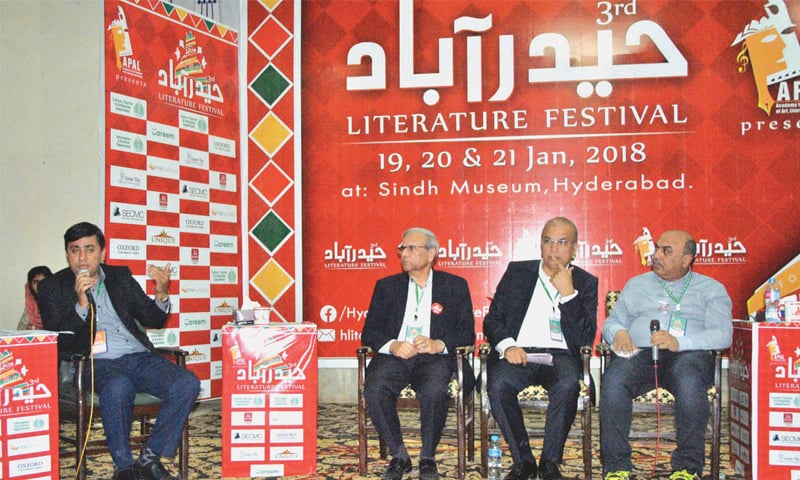

HYDERABAD: The controversial issue of Gorano effluent reservoir in Tharparkar echoed at one of the sessions on the concluding day at the three-day Hyderabad Literature Festival (HLF) that drew to an end on Sunday evening.
Apparently, the controversial issue came to light at the final day’s programme when Tharis affected by the reservoir registered their strong protest over not being given representation on the stage.
The session discussed ‘Thar coal: prospects for future’. It was the Thari community’s concerns and protests that prompted eminent economist Dr Kaiser Bengali — who was among the panellists — to say: “While Thar coal project will certainly lead to benefits, there is a dire need to pay attention to the price that the community is going to pay”.
The Tharis protested that festival organisers did give space to SECMC (Sindh Engro Coal Mining Company) representative but there was none on the stage to talk about the community’s narrative and concerns. After giving vent to their feelings against construction of the reservoir by the SECMC, which they believe was affecting their sources of livelihood, they walked out of the session.
Dr Bengali started the discussion by saying that everything had a cost and benefit. “Development has a cost and environmental impacts. Every development doesn’t have equal distributional impact,” he said, adding: “Every development project must be backed by a debate so that community whose interests are to be affected must become part of decision-making.”
He said the coal project would certainly lead to establishment of new cities and job opportunities but there was a cost to be paid. “Perhaps we must see the aspect of price of development to be paid by community. Will it benefit people of Thar; or outsiders will find new abodes there? Gawadar’s debate revolves around same question. Some steps are taken and more are needed to protect rights of locals who have first right to get fruits of development,” he said.
He said that desert has a clean environment and what one must see was that the air was going to be polluted due to coal’s extraction or will it affect water quality. Gorano’s issue is all about groundwater aquifer due to storage of saline water. A displacement is there like any other project. Moot point is how it is to be compensated or resettled so that social engineering of community is not disturbed.
He remarked: “Development’s human factor is crucial,” and urged the company that has undertaken mining in the region to use technology in checking air pollution and water contamination.
“Growth of new houses in Islamkot indicates as if a katchi abadi is emerging. A planned development is needed for new settlement,” said the economist.
He underscored the need for conserving cultural and religious heritage of Thar. “Two-thirds of Thar should be declared ‘national park’ with ban on multi-storey construction and establishment of smoke smack industry,” he stressed.
SECMC’s corporate social responsibility (CSR) wing head Naseer Memon, a writer who has recently joined the company, was mentally prepared for the protest. He tackled them politely, asking the audience to have a serious debate over the issues to raise macro-level questions. “I find Gorano reservoir a dot in Thar’s future as many will surface when more companies start working,” he said. The technical studies on disposal sites were done and they could be shared with others, he added.
The pandemonium started when journalist Sohail Sangi, himself a Thari, at the outset of the session objected that “company [SECMC] representative can hold a news conference to present its case. There is none to give community’s narrative,” Memon argued that Thar coal and Engro were not synonymous as 13 blocks were there, too. He that all pro-Sindh and pro-Thar forces should look at the issue seriously and if it was not done, then everyone would only rue something after five to 10 years.A former diplomat and head of Sindh Vision, Ali Mardan Rahujo, also expressed his views.
Inam Sheikh, Dr Shaheen Ashraf and Waheeda Mahesar discussed ‘Challenges and opportunities to education sector’.
The session on ‘Problems and prospects of higher education’ also ended abruptly after Sindh University students registered their protest over increase in fees and provision of a charity’s food to varsity students. They raised placards inscribed with such slogans in front of vice chancellor Dr Fateh Mohammad Burfat, who was sitting on the stage. He and Liaquat University of Medical and Health Sciences vice chancellor Dr Bikha Ram took part in the discussion.
Published in Dawn, January 22nd, 2018