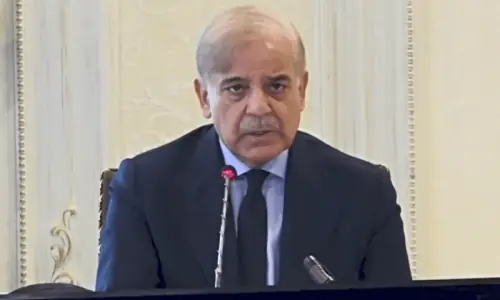
ISLAMABAD: Prime Minister Shahid Khaqan Abbasi announced on Wednesday the government’s intentions to offer an amnesty scheme for Pakistanis to declare their foreign assets, and reduce tax rates to broaden the tax base and address challenges on the external and fiscal fronts, ahead of next year’s budget and the upcoming general elections.
“We will bring a one-time amnesty scheme,” said the prime minister, confirming recent reports that the government was working on a scheme to allow Pakistanis to declare their assets abroad.
Speaking at an event organised by the Pakistan Business Council (PBC), he said there was a need to lower tax rates, bring wealthy individuals into the tax net and push deeper tax reforms.
Another way could be the use of technology, with the help of the National Database and Registration Authority (Nadra) to identify prospective taxpayers to address the country’s fiscal challenges, he said.
Business community calls on Abbasi to share CPEC plan, include them to ensure its implementation
Former State Bank governor Dr Ishrat Hussain also advised the government to follow the Indonesian example, which materialised $30-40 billion by offering an amnesty scheme to attract people to declare their foreign assets.
He also suggested other measures to address external account vulnerabilities after the PBC called for sharing the China-Pakistan Economic Corridor (CPEC) plan with the business community and sought the establishment of a monitoring mechanism to ensure its implementation and the maintenance of a correct trade imbalance with China.
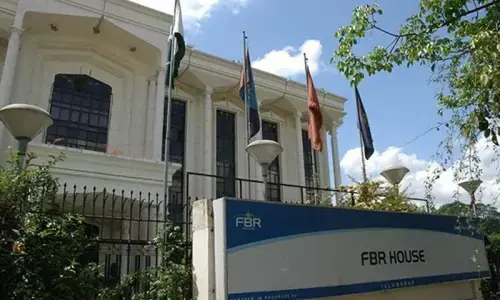
The prime minister said that high corporate sector tax rates were not sustainable and would be brought down, while technology would be used to curb tax evasion by identifying individuals who failed to justify their consumption patterns. He deplored that a tax base of 1.2 million filers was dismally low, and lamented that the Federal Board of Revenue (FBR) collected just Rs200 billion out of a possible Rs4,000 billion, which was less than 5pc of the country’s potential.
He stressed the need to take remedial measures by undertaking tax reforms, including lowering tax slabs for individual and corporate taxpayers and jacking up the minimum taxable limit for individuals. The loss in revenue after reducing tax rates could be offset by bringing more taxpayers into the tax net, he emphasised.
PM Abbasi said the government and the business community agreed on most economic issues, but now was the time to develop a roadmap to reach their goals. He said it was clear that the country’s performance was below-par, adding that a deliverable plan was needed to unleash its true potential.
He said the Pakistan Muslim League-Nawaz (PML-N) had won the 2013 elections and promised to address law and order issues, overcome the energy crisis and improve the country’s economic conditions, claiming that the government had restored the law and order situation to a large extent and the country was now a much better place to live.
Secondly, he said, the government had not overcome the energy crisis, but had set the stage for no electricity shortages until 2030. However, the prime minister conceded that a lot of inefficiencies still existed, resulting in the circular debt crisis, which was “a serious concern”.
The prime minister said that exports worth $20 billion were quite low and needed to be doubled, for which export products would have to become competitive to get their due share in the international market. He said the government could not increase exports, but could facilitate exporters and manufacturers to achieve the desired results.
On its part, the government has arranged a big opportunity in the form of China-Pakistan Economic Corridor (CPEC) and the business community should take full benefit of the opportunities, he said.
Dr Ishrat suggested a set of actions to address external challenges in the short run and said the export package announced by the government should have continuity so that business had the incentive to deliver on export growth. The prime minister, he advised, should regularly sit with the exporters, give them targets, address their problems and follow up on deliverables to achieve higher export growth. He said more incentives should be given for foreign remittances to flow through the official channel so that higher revenues were available.
He said there were discrepancies in foreign direct investment data reported by the central bank and tax authorities on account of the import of machinery from China. The gap between two sources was earlier $2 billion which had now doubled to $4 billion which needed to be reconciled at the earliest.
Published in Dawn, January 18th, 2018