RAWALPINDI, May 7: President General Pervez Musharraf has emphasized that the quest for Kashmir settlement could not go on indefinitely and there is a growing realization in India and the international community that the long-standing Jammu and Kashmir dispute must be resolved permanently for lasting peace and progress in South Asia.
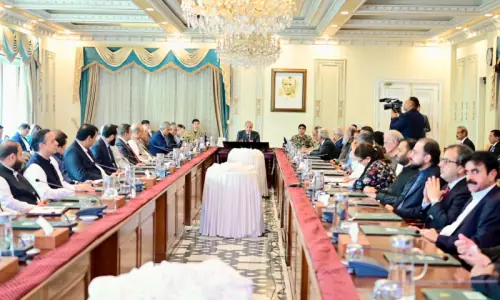
He was addressing senior civil servants of the 82nd National Management Course at the Pakistan Administrative Staff College, who called on him here on Saturday. President Musharraf said the past accords between Pakistan and India failed to establish durable peace as they did not address the underlying cause of tension.
He pointed out that in the changed international environment the world had also realized that coercive diplomacy cannot lead to durable settlement of lingering disputes, including Kashmir. He said: “The international community views Kashmir as a flashpoint in the post-2002 stand-off between Pakistan and India and feels that a peaceful resolution to the problem is imperative.”
Referring to the peace process between the two countries, the president said Pakistan believed that confidence-building measures and composite dialogue should move in tandem.
On the Muzaffarabad-Srinagar bus service, he said: “It has been commenced to help the Kashmiris meet their divided families.” In his address, the president touched upon key challenges and opportunities the country faces today and asked the civil servants to be agents of change and serve as facilitators.
He said: “The bureaucracy should serve as facilitators of service to the people and blockers of corruption, a malaise that harmed the country in the past.”
“You should not shy from even recommending amendments in the rules that impede provision of efficient services to the people — you should guarantee progress and prosperity and never let the nation down,” he urged. President Musharraf also underlined to the higher tiers of civil service to set a personal example for their subordinates to emulate and adhere strictly to the policy of merit.
He said: “You must always remember that the nation comes first. We have introduced reforms to make the system subservient to the people and now it is your duty to deliver above all considerations. At the same time, civil servants should strive for achieving expertise in their fields.” Responding to a question, he said the local government system has introduced the much-needed checks and balances. He said the Nazim, being an elected representative of the people, is responsible for good governance at the grass-roots level and, therefore, has been entrusted with administrative powers.—APP