1
1

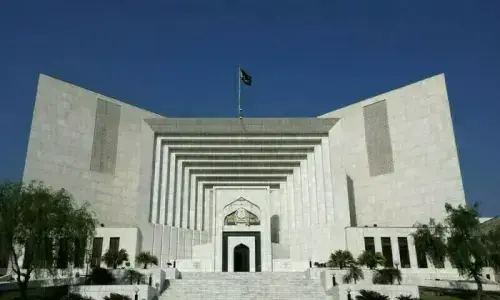
ISLAMABAD: The growing disparity and discrimination in the education system caught the attention of the Supreme Court when Chief Justice Mian Saqib Nisar questioned on Tuesday why the concept of “one textbook, one school bag and one uniform” in our educational institutions cannot be launched.
“If we cannot enforce Article 25A of the Constitution in its true spirit then it’s a mere showpiece in the green book,” regretted the chief justice while holding the Constitution in his left hand.
The chief justice was heading a three-judge bench.
Article 25A of the Constitution obligates the state to provide free and compulsory education to all children of the age of five to 16 years.
The observation came when senior counsel Mohammad Akram Sheikh argued before the court that the students of A-level system should not be given preferential treatment because the indigenous education system would blow up since such students already had two opportunities for getting admission in the medical colleges by taking the entry test or fall in the 15 per cent quota reserved for them.
The counsel was representing the Pakistan Medical and Dental Council (PMDC) in an appeal against the Dec 7, 2017, judgement of the Lahore High Court (LHC) which had struck down PMDC’s admission regulations, 2016, introduced for the merit-based admission process.
Another senior counsel Latif Khosa, who was sitting in the courtroom, said that according to his assessment around 30 million children in the country did not go to schools.
Says if we cannot enforce Article 25A in its true spirit then it’s a mere showpiece in the Constitution
The chief justice wondered whether anybody had ever done research what system in Japan was in place. Innocent children should not be discriminated against because it was not their fault. Children belonging to the affluent class could afford a different education standard that broadened their intellectual horizons, but then it would be unequal competition for other students, the chief justice observed, adding that there should be fair competition among the students.
At this the counsel emphasised that the competitions should be among equals, adding that even if his grandchildren wanted to get admission to the University of Oxford because they could afford it, they would still have to abide by the criteria. He highlighted 90pc literary rate among the children between the age brackets of five to 16 years old in Sri Lanka and said feudal lords in Pakistan discouraged opening of schools in their areas.
CJ Saqib Nisar, however, hastened to add that the court was not deprecating the students merely because they were seeking the Cambridge education system. They were very hard-working students, but there should be a uniform system of education for our children because it was the right of every child that he should be given ample opportunity by the state to get quality education.
Some legislation had to be brought to do away with such a menace, the chief justice observed, adding that he would soon invite the legislators and other stakeholders to fight together this menace because parliament was the supreme body and it fell within their domain to find out solutions to rectify such a state of affairs.
The chief justice recalled how former judge Prof Aharon Barak argued in his book The Judge in a Democracy about the role of the judiciary for the enforcement of fundamental rights in democracy.
The biggest jewel a parent can give to his children is education to inculcate the skill to differentiate between the vices and to earn his livelihood in a decent manner, the chief justice said.
The hearing of the case will again be taken up on Wednesday when Dr Asim Hussain, a close confidant of former president Asif Zardari will appear in person before the court.
On Monday last the court had issued a notice when Akram Sheikh had accused Dr Hussain of regulatory capture of the PMDC under his leadership as being the PMDC president and vice chancellor of the Ziauddin Medical and Dental College.
It was during Dr Hussain’s time that the private medical colleges were affiliated with the council in such a large number that these colleges overwhelmed the independent professionals from the longstanding public medical colleges, the counsel had argued.
Published in Dawn, January 10th, 2018