0
0
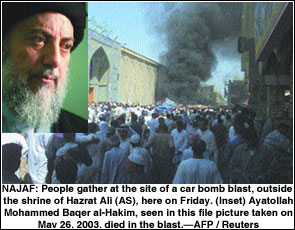 NAJAF, Aug 29: A car bomb killed at least 82 people, including Iraq’s leading Shia leader Ayatollah Hakim, and wounded more than 200 in Najaf on Friday.
Ayatollah Mohammad Baqer al Hakim, head of the Iran-backed Supreme Council of the Islamic Revolution in Iraq (SCIRI), was killed moments after he delivered his Friday sermon at the shrine of Hazrat Ali in the holy city, 180kms south of Baghdad, party officials said in both Baghdad and Tehran.
The bombing was the deadliest in the Middle East since Oct 23, 1983, when 241 US marines and 58 French soldiers deployed with a multinational force in Lebanon were killed in double truck bombings of their headquarters in Beirut.
Ayatollah Hakim, a moderate who spent some 20 years in exile in Iran before his triumphant return in May, “met a martyr’s fate along with his bodyguards”, Mohsen al Hakim, the son and political adviser of Abdel Aziz, the ayatollah’s brother and a member of the US-sponsored Governing Council, said in Tehran.
“Hakim died in a car bomb explosion on Friday afternoon after prayers,” said SCIRI official Adel Abdel Mahdi in Baghdad about an attack that was also the deadliest in the world since last October’s Bali bombing, which claimed more than 200 lives.
The car exploded outside the shrine’s southern gate, where Ayatollah Hakim normally entered and exited on Fridays.
In his final speech, the religious leader had vigorously denounced former president Saddam Hussein and his now-banned Baath party, accusing them of orchestrating attacks against the US-led forces.
Sheikh Saad Abbas, an overseer at the mosque compound, said “this operation has targeted the shrine of Imam Ali”. “It has been carried out by movements that hate the Shias. They are targeting the family of Hakim.”
Only five days ago, Najaf was shaken by an assassination attempt on Ayatollah Hakim’s uncle, Grand Ayatollah Seyed Mohammad Said al Hakim, who narrowly escaped death in a bomb attack that killed three people.
Many suspected the hand of Saddam Hussein’s loyalists and foreign terrorists in Friday’s blast.
Ahmad Chalabi, leader of the Pentagon-backed Iraqi National Congress (INC), blamed remnants of Saddam Hussein’s government and supporters of the Al Qaeda network for the attack.
“Fundamentalists and Al Qaeda supporters are working hand in glove with remnants of the Saddam regime” to sow chaos in Iraq, Mr Chalabi charged.
Shopowner Hadi Jassem cried: “This is the act of the Saddam loyalists, the men from Tikrit, Ramadi and Fallujah who have done this crime.”
Others believe that the blast, and the murder of pro-Western Shia leader Sayyed Abdul Majid al Khoei at the Tomb of Hazrat Ali in April, are the product of a dangerous rivalry among the country’s prominent Shia leaders for the mantle of leadership among the community of some 15 million people.
Friday’s explosion went off next to Ayatollah Hakim’s black Landcruiser and gutted the vehicles of three of his bodyguards, along with a police car and four other vehicles, one of which was thrown against the wall of the mosque.
An angry crowd outside shouted slogans against Saddam Hussein and the Baathists as rescuers scoured the heaps of brick and metal for survivors.
Several shops were gutted by the blast, which struck as the faithful left after Friday prayers.
Scattered sandals and headdresses lay abandoned in pools of blood.
Smoke filled the area as five charred cars burned, with one thrown at least 100 metres.
People were buried beneath the rubble of a gate to the compound and of a nearby restaurant and a shop, which were flattened by the explosion.
Iraqi police supervised rescue efforts as a few US soldiers looked on. Onlookers shouted “Allahu Akbar” every time a body was lifted from the heap of metal and brick.
Outdoor vendors and worshippers had gashes on their faces from flying glass.
One witness said the car that exploded was a Volkswagen Passat, typically used as a taxi around Iraq. “A burnt body was in the car,” he said.
An announcement over the mosque’s loudspeakers urged residents to go to the local children’s hospital to donate blood.
The offices of firebrand anti-American leader Moqtada Sadr were also damaged in the blast.
The gates of the mosque were shuttered and guarded by dozens of Iraqi police, while three fire trucks were positioned around the compound.
Police hauled away cars left in the area for fear that more bombs might be hidden.
Dozens of people jostled one another as they looked for signs of life amid the wreckage at the holy site.
A man cried: “Where is my son, son,” before spotting the boy, wounded in the leg, and grabbing him in a firm embrace.
Hundreds gathered outside the closed gates of the city’s educational hospital wanting to donate blood to the wounded.
The death of Ayatollah Hakim was a hard blow to the US-led forces as his brother, Abdel Aziz, sits on the US-appointed Governing Council and had made a tacit alliance with the occupying power.
The US overseer in Iraq, Paul Bremer, vowed to find the masterminds of the attack, the latest major challenge to order in the country after the suicide bombing of the UN headquarters in Baghdad on Aug 19 that killed 24 people.
“The Iraqi police have our full cooperation in this important investigation. I pledge that the coalition will do everything possible to see that the perpetrators are brought to justice.”
Some of their SCIRI associates were working on US-sponsored regional councils in the south and had generally been seen as a stabilizing force in Iraq, despite US reservations about the group’s close ties with Iran.
The ayatollah stood along with Grand Ayatollah Ali al Sistani in refusing calls from young firebrands like Moqtada Sadr for the Americans to immediately leave the country.
For his part, Moqtada Sadr condemned Friday’s attack and pointed the finger at Baathists, but he also lashed out once more at the Americans.—AFP