URDU pronunciation of some Pakistani TV channels is giving nightmares to many, though the owners and anchors of those channels may not even be aware how mercilessly they have been slaughtering our national language.
Aside from intermingling English words and phrases with their Urdu conversation, these innocent anchors mispronounce many Urdu words, sometime rendering the sentence ridiculously incorrect. Another matter of concern is TV channels’ non-standard grammar. For example Urdu word awaam (public) is now being used by TV channels as singular and feminine, while in fact it is plural of aam and has always been used as masculine.
Grammar or pronunciation-related issues are usually settled by referring to dictionaries as most dictionaries do take care of pronunciation and expressly mention it. When it comes to pronunciation, the English language has many works to offer. One of the most remarkable works in the field of English lexicography is The English Pronouncing Dictionary. Compiled by Daniel Jones (1881-1967) and first published in 1917, the dictionary is still available in updated versions.
A professor of phonetics at University College London, Daniel Jones is known for his landmark works in the field of phonetics. He was the first to have ever used the word ‘phoneme’ in its present sense: the minimal unit of sound; a distinct sound in a particular language distinguishing one word from another.
In addition to his writings on English phonology and phonetics, Jones is credited with the concept of cardinal vowels in English. His famous and much-reproduced trapezium, showing how the tongue changes its positions when the vowels are pronounced, is still widely used to explain what is referred to in linguistics as ‘articulation’ of vowels.
Jones’ definition of ‘model’ pronunciation, however, changed with time. In the beginning, to refer to a standard pronunciation being the characteristic of the speech of educated British speakers of the English language, he used the term ‘Public School Pronunciation’ (PSP), as he thought that the students in those schools lost their “local peculiarities” and used a pronunciation that was most usually heard in everyday speech.
Later, he changed the term for a standard pronunciation from PSP to ‘Received Pronunciation’ (RP), being the educated pronunciation heard especially in and around London. The editor of the 14th edition of Jones’ dictionary wrote that the term ‘Received Pronunciation’ was no more tenable but retained it anyway because of the “wide currency” of the label. According to the latest edition of the dictionary, the accent of the English language Jones was referring to is now generally called ‘British English’.
Coming back to Urdu pronunciation of certain words, the question of Urdu’s pronunciation is trickier: not only is Urdu spoken in very wide regions of the subcontinent with its localised variants, a large number of Arabic and Persian words assimilated into Urdu have lost their original pronunciation and, in many cases, their original meanings. A particular Urdu word, whether originating from Arabic or Persian, or Sanskrit or Prakrit, may have variant pronunciations and/or spellings. Also, the grammatical usage may be surprisingly different. For instance, ‘bulbul’ (nightingale) and ‘dahi’ (curd, yogurt) can be used either as masculine or feminine.
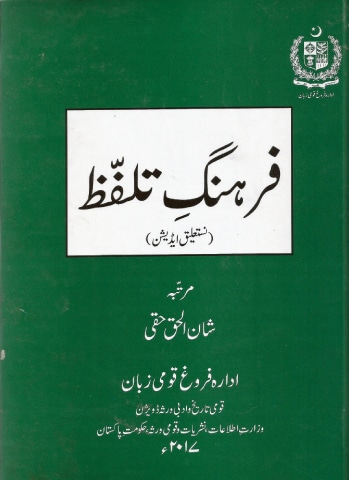
To address such contentious issues and settling the debate on variations in pronunciations, a pronouncing dictionary of Urdu was needed. And only a scholar of Shanul Haq Haqqee’s stature would have carried out the task. During his first incumbency as chairman at Muqtadira Qaumi Zaban, or National Language Authority, now renamed as Idara-i-Farogh-i-Qaumi Zaban, (IFQZ) Iftikhar Arif asked Haqqee Sahib to compile a pronouncing dictionary of Urdu. So Shanul Haq Haqqee compiled Farhang-i-Talaffuz, one of the few of Urdu’s pronouncing dictionaries.
The dictionary takes care of variant pronunciations, mentioning them when and where needed. A special feature was the system used to mention the pronunciation: to make sure the pronunciation is clearly understood, it used the diacritical marks (zer, zabar, pesh, etc) as well as abbreviations in the parenthesis that described the individual diacritical mark for each letter separately. In Urdu, the dual system of showing diacritical marks is known as ‘maktoobi’ (written) and ‘malfoozi’ (uttered). In some cases, words that are apparently plural but are often used as singular, or vice versa, too, were taken care of.
The subsequent editions published during the tenures of Prof Fateh Muhammad Malik and Dr Anwaar Ahmed addressed the problem of some errors pointed out by some critics earlier. Now the new, 732-page, fourth edition of Farhang-i-Talaffuz has just been published by IFQZ. The special feature this time around is that it has been recomposed in ‘Nast’aleeq’ script, which is more beautiful and is more favoured in Urdu. Iftikhar Arif, now director general of IFQZ, in his intro has mentioned the fact that 2017 marks the 100th birth anniversary of Haqqee Sahib and this newly composed edition coincides with the centenary celebrations.
It is indeed a befitting tribute to a great linguist and lexicographer like Haqqee. One sincerely hopes that our TV channels would take full advantage of this much-needed new edition.
Published in Dawn, November 14th, 2017