China's Xi secures second term with no heir in sight


President Xi Jinping was formally handed a second term on Wednesday, with no clear successor emerging in a revamped ruling council, cementing his grip on power and setting the stage for him to dominate China for decades to come.
In a highly choreographed event, Xi led the new members of the elite Politburo Standing Committee in front of television cameras at Beijing's massive Great Hall of the People after their selection by 204 party officials in a closed-door vote.
Xi, 64, secured a second five-year term as general secretary of the Communist Party after his eponymous political theory was enshrined in its constitution, giving him an inviolable mandate to rule and possibly positioning him to retain power for much longer.
He was also reappointed head of the country's Central Military Commission.
Premier Li Keqiang, 62, retained his seat on the seven-member committee while five other men — all little known outside China — replaced comrades who had reached an informal retirement age of 68.

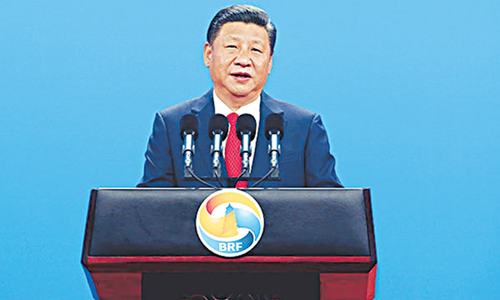
In a speech, as the other members stood expressionless in dark suits, Xi heralded a "new era" for the country under his rule and said the party "must get a new look and more importantly make new accomplishments."
But the new ruling council looked decidedly old, raising doubts that any could succeed Xi.
"Xi Jinping doesn't want to share power. He doesn't want someone breathing down his neck, preparing the succession," Jean-Pierre Cabestan, China specialist at Hong Kong Baptist University, told AFP. "He wants to keep pressure on everybody and enjoy power for five or 10 years without having his hands tied."
All the committee's members are at least 60 years of age. Under the current rules, they would be too old to serve the customary two terms as the party's leader at the next congress in 2022.
Xi was elevated to the committee in 2007, when he was 54, and succeeded Hu Jintao as general secretary and president five years later.
Anti-graft crusade
In the past two administrations, decisions were the result of horse-trading and consultation among members of the standing committee, the council of party elders which has led China since Deng's death in 1997.
But with his name in the constitution, Xi has become the nation's ultimate authority, likely giving him the last word on all major decisions.
The document's "all-round embracing of Xi's thought reflects the high degree of consensus the Party has built around its leadership core," the state-run China Daily wrote in an editorial Wednesday.
During his speech, Xi called for ever stricter management of the party, suggesting his grip on power will only increase.
Over the last five years, he has waged a ruthless campaign on official corruption, but party discipline is "a journey to which there is no end," he said, calling on members to "rid ourselves of any virus that erodes the party's fabric."
At least one important figure did not make the cut, as Xi's right-hand man Wang Qishan, 69, vacated his standing committee seat.
Analysts had thought the leader of the country's anti-corruption campaign might be kept on in defiance of the party's unofficial guideline that cadres retire at 68.
The BBC, The Economist, the Financial Times, The Guardian and the New York Times were denied invitations to cover the unveiling despite wide access granted to other news outlets, according to the Foreign Correspondents’ Club of China.
“It is hard to avoid the conclusion that these media organisations have been singled out to send a message,” it said in a statement, adding that using access as a tool to punish journalists violated principles of press freedom.