LAST year this writer had a chance to attend an international conference in Islamabad. Organised by a university, the conference was convened to discuss Pakistan’s language policy. Ironically, the language of the conference was English, a language hardly understood by 10 per cent of Pakistanis.
The keynote address was delivered by an American academic of Indian origin. Most of the foreign delegates did not know a single word of any Pakistani language. Neither were these foreigners, albeit scholars, experts on Pakistan’s history or culture and yet they actively participated in the debates, discussing what should be Pakistan’s language policy.
Interestingly, most of the Pakistani speakers were axed from the committee that was entrusted with preparing the recommendations and foreigners were preferred on that committee. One can well imagine what would have been the recommendations sent to the concerned authorities to formulate Pakistan’s language policy.
As if all this was not enough, the topic this writer was asked to discuss was ‘The regional languages of Pakistan’. Beginning with the remark that ‘regional languages’ and ‘provincial languages’ were derogatory terms, this writer informed the participants and the organisers that the government of Pakistan had years ago decided that all languages spoken in Pakistan were to be called ‘Pakistani languages’. The university organising the event was just a little behind the clock, say, only by a few decades, as Islamabad’s Allama Iqbal Open University takes pride in the fact that it had decades ago correctly named its concerned department as ‘Pakistani Languages Department’, even before the government’s recommendation to the effect.
But it was not surprising as most people, including academics and media persons, refer to Pakistani languages as regional languages or provincial languages, though this is the kind of treatment that sparks resentment among the speakers of Pakistani languages and is tantamount to adding fuel to the linguistic fire that has been raging in Pakistan ever since it came into existence.
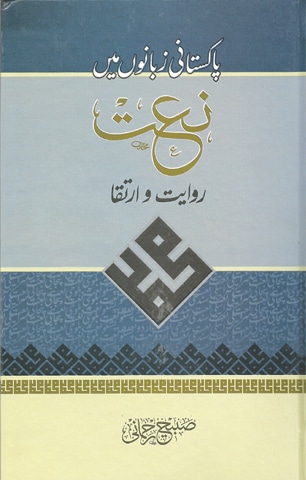
The episode that took place last year at Islamabad’s university began to reverberate in mind when a new book titled Pakistani zabanon mein naat: rivayet-o-irtiqa was received. Aptly titled and just published by Karachi’s Naat Research Centre, the book deserves kudos as it successfully captures the essence and brief history of the genre of naat in different Pakistani languages. These languages include Punjabi, Sindhi, Balochi, Pashto, Seraiki, Brahvi, Kashmiri, Hindko, Gojari and Campbellpuri boli.
Sabeeh Rahmani, a well-known naat-khwan, poet and editor of magazine Naat rang, has edited and compiled in this volume 26 articles on the history and development of naat in these Pakistani languages. The articles included are written by some of the well-known scholars of Pakistani languages, such as, Memon Abdul Majeed Sindhi, Kamil-ul-Qadri, Wahid Bakhsh Buzdaar, Nawaz Ali Shauq, Khatir Ghaznavi, Afaq Siddiqi, Hafeez Taaib, Inam-ul-Haq Kausar, Mehr Abdul Haq, Tahir Taunsavi, Abdur Rahman Brahvi, Sabir Afaqi, Ghulam Hussain Azhar, Arshad Mahmood Nashad and some others.
In his intro to the book Rahmani says that literature is essentially a reflection of the society and environment it is created in. Literature of any language mirrors the in-depth feelings and cultural affiliations of the people. So do the Pakistani languages, and their poetry proves that these languages are tied together with a common thread that runs through them all since the cultural, social and historical background and religious ethos are shared by them, he adds.
The articles included in the book prove that the poetry of almost every Pakistani language has a long history of composing naat — the poetry praising, paying respect and expressing love for the Prophet of Islam Hazrat Muhammad (PBUH). It is this shared characteristic, a common heritage, among other things, that brings Pakistani languages closer.
Both Iftikhar Arif and Dr Anwaar Ahmed in the book’s blurbs have paid tributes to Sabeeh Rahmani for this unique effort. They say that every language of Pakistan expresses almost similar emotions of extreme love for the Prophet (PBUH). Iftikhar Arif says that comparing the naat tradition in Pakistani languages with the ones found in other major languages of the Islamic world brings a joy and satisfaction that if our languages do not get ahead of the other languages they are at least not behind them when it comes to praising the Prophet of Islam (PBUH).
Dr Anwaar Ahmed says that in a language, any language, whether spoken in a specific area or province, the heart of the people can be heard beating and the name we hear in that heartbeat is the one and same. So is the way of expressing love.
It has now been about 30 years that Sabeeh Rahmani has been working to promote naat as a literary genre. Sabeeh has rightly used the phrase “Pakistani languages” and it shows that a poet and researcher of naat can be more aware and sensitive about certain linguistic terms than the university professors.
Published in Dawn, October 10th, 2017