3 Americans win Nobel medicine prize for body rhythm work
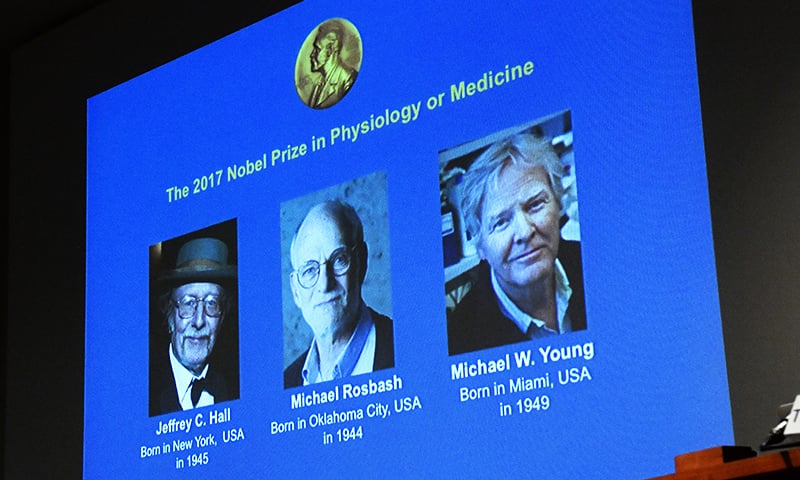

The Nobel Prize in Physiology or Medicine was awarded to three Americans on Monday for discoveries about the body's daily rhythms.
The laureates are Jeffrey C. Hall, Michael Rosbash and Michael W. Young. Rosbash is on the faculty at Brandeis University, Young at Rockefeller University and Hall has been associated with the University of Maine.
The citation for the 9-million-kronor ($1.1 million) prize says the researchers isolated a gene that controls the normal daily biological rhythm.
They “were able to peek inside our biological clock and elucidate its inner workings.”
Circadian rhythms adapt the workings of the body to different phases of the day, influencing sleep, behaviour, hormone levels, body temperature and metabolism.
The winners have raised “awareness of the importance of a proper sleep hygiene” said Juleen Zierath of the Nobel academy.
The awardees' work stems back to 1984, when Rosbash and Hall, who was then also at Brandeis, along with Young isolated the “period gene” in fruit flies.
Hall and Rosbash found that a protein encoded by the gene accumulated during the night and degraded during daytime.
A decade later, Young discovered another “clock gene.”
“The paradigm-shifting discoveries by the laureates established key mechanisms for the biological clock,” the Nobel Assembly said in its prize statement.
“Our wellbeing is affected when there is a temporary mismatch between our external environment and this internal biological clock, for example when we travel across several time zones and experience 'jet lag,'” the statement said.
“There are also indications that chronic misalignment between our lifestyle and the rhythm dictated by our inner time keeper is associated with increased risk for various diseases. “