Kashmiri man used as human shield by Indian army had voted prior to capture: report


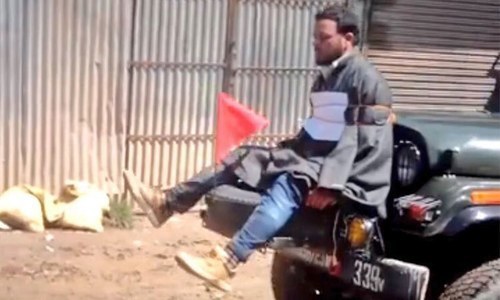
A police inquiry into the use of a Kashmiri man as a human shield by the Indian army on the day of by-polls in Srinagar has found that the man in question had, as he claimed, cast his vote before he was detained, tied to the bonnet of an army jeep, and paraded through several villages in the Budgam district, Scroll.in reported on Monday.
On April 9, Farooq Ahmed Dar was made a human shield to 'deter' stone-pelting dissidents in the disputed territory. The move had drawn sharp criticism from observers, but earned the officer responsible for the decision accolades from the Indian army.
The Indian government, too, had defended the action.
According to Scroll.in, a report on the incident — which was compiled in August — had come to light on Monday.
In it, police said: “During investigation, it came to surface that the victim Farooq Ahmad Dar cast his vote at polling booth in his native village, Chill. After casting his vote, he, along with Hilal Ahmad Magrey, left for a condolence meeting to Gampora.”
Dar was taken into custody by the Indian army “during stone pelting, and was tied to the bonnet of a vehicle as human shield under threat”.
“He was kept under wrongful confinement and was paraded/moved around in the area,” the report read, Scroll.in reported.
In May, the Indian army had announced that Indian Army Chief Gen Bipin Rawat had awarded a commendation to Maj Leetul Gogoi, the military officer whose decision it was to use Dar as a human shield.
At the time, The Hindu had described the move as surprising and had said the army chief’s decision came even though the Court of Inquiry against the officer had yet to conclude its probe at the time.
"I was a human shield": Read a Kashmiri man's recollection here.
According to Scroll.in, only 7.1 per cent of registered voters in Srinagar had cast their votes during the election.
In Budgam district, Dar was among the only 31,476 people who had voted, Scroll.in said.
Separatist factions in Kashmir had called for a boycott of the vote, resulting in heightened security and low voter turnout when the polling began.
In Budgam district, Indian police had initially used tear gas against protesters who were throwing stones, but then opened fire, killing six, an official had said at the time.
More than two dozen people were injured during clashes across central held Kashmir, the official had said on the day of the by-poll.
At least 70 polling stations were shut due to the violence, while at some stations voting machines were set ablaze by protesters.
Indian soldiers kill four separatists in Kashmir
Indian soldiers killed four separatists during a two-day gun battle near the de facto border in Kashmir that demarcates India-held Kashmir from Pakistan, officials said on Monday.
Police claimed civilians tipped them off on Saturday about the movement of armed separatists near the Line of Control (LoC), prompting a search.
Three of the separatists were killed Sunday at three different locations, including at a mosque, a police statement said.
Indian army spokesman Colonel Rajesh Kalia said Monday that a fourth separatist was killed during the continuing search operation of the area.
Four civilians and a soldier were also wounded during the shootouts.