WITH Pakistan’s population at 207.8 million and an annual growth rate of 2.4 per cent, alarm bells must be ringing for policymakers.
A key issue is how census managers have handled Pakistan’s urban question, its impact on basic services management and urban planning to adapt to the effects of climate change. Numerous studies show that temperatures in South Asia will exceed habitable levels by the end of this century. Disruptions in agricultural outputs and economies will trigger deepening vulnerabilities at every level, from the individual to the country.
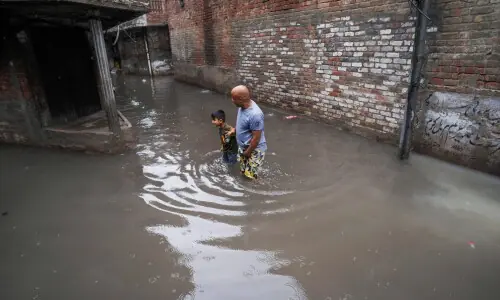
Climate change is already palpable in Sindh’s cities: coastal storm surges, rising sea levels, hotter summers, unprecedented floods and unpredictable precipitation. Pakistan’s expanding urban ecological footprint is most visible at the rural-urban interface where we find spaces of intense marginalisation, and exacerbated by decades of poor planning, incompetent engineering and avaricious development — compromising local ecologies that could withstand the shock of natural disasters.
The provisional census results show urbanisation at 36.4pc. The 1998 census determined urbanisation at 32.5pc, a figure that drew censure from various groups, with critics arguing that the conventional definition of ‘urban’ (confined to notified municipal limits) was inadequate for understanding the ground realities of rapid urbanisation.
Conventional census methodology does not consider the extensive transformation along the peripheries of large- and medium-sized cities, clustered urban locations along diverse types of mobilities and water bodies, enterprise-based urban locations around major industries and other establishments.
The definition of ‘urban’ needs to be revisited.
Indubitably, debates will continue as the statistics bureau discloses the conclusive results in April 2018. Political parties, community groups and civil society, including demographers have all voiced concerns about the partial results.
Misgivings stem from concerns about the handling and compilation of data in Islamabad rather than at the provincial level as was previously done. Additionally, dynamics like displacements and migrations from KP to large cities (especially Karachi), in-migrations to urban Sindh, horizontal population movement and consequent densification of cities have hardly surfaced in the partial results. When Sindh’s growth rate is less than that of Balochistan and KP, it raises concerns about how the census was undertaken. If Sindh’s urbanisation levels are deliberately understated, it will have grave, long-term consequences for planning and governance to mitigate climate change.
High population growth in our cities has generated many challenges that the state has never addressed, particularly the need for social housing. Instead, with state land abundant in several cities, katchi abadis proliferate. But the ‘guardians’ of agrarian land in peri-urban locations have also contributed to the expansion of informal settlements, real-estate developments and gated communities. Urban land, once considered a social asset, is now a commodity. Affordable housing has vanished — exacerbated by burgeoning land prices, high construction costs, low savings/capital accumulation among disadvantaged groups and lack of housing credit.
As in-migration to Karachi grows, migrants find shelter in katchi abadis that act as shock absorbers, mitigating certain kinds of risks for low-income groups. But this is hardly a solution. Uneven settlements, fragmented infrastructures, and environmental and social hazards constantly endanger lives in katchi abadis.
The census is more than an exercise in counting and recording basic information about everyone in Pakistan. It is also the first step in assessing the social, demographic and economic status of populations and the contexts they inhabit — which has a bearing on poverty, development, resources, budgets, constituencies, etc.
It also assesses the impact of past public investments in health, education, welfare and infrastructure. Hence, the census paves the way for various policy interventions. But this does not remove a key problem: just because you have sampled and measured populations doesn’t mean you can manage them. Nevertheless, numbers and calculations are important in policy agendas, and census methodologies underwrite concrete policy outcomes.
The definition of ‘urban’ and urbanisation parameters need to be revisited to enable policy decisions grounded in reality. In the coming decades, resource allocations, development programmes and infrastructural preferences will shape Pakistan’s future. That this future is embedded in a new global urbanisation conjuncture, and associated anthropogenic effects, necessitates recasting census methodologies to better equip us with data reflecting ground realities.
Noman Ahmed is chairman, Department of Architecture & Planning, NED University, Karachi.
Nausheen H. Anwar is associate professor, Department of Social Sciences & Liberal Arts, IBA, Karachi.
Published in Dawn, September 13th, 2017