Chinese President Xi Jinping on Monday opened an annual summit of BRICS leaders meant to underline Beijing's claim to developing-world leadership, but which has been upstaged by North Korea's latest nuclear test. The countries also expressed concern over several terror groups.
The BRICS — Brazil, Russia, India, China and South Africa — gathered in the southeastern Chinese city of Xiamen hoping to counter accusations the grouping was becoming irrelevant.
The countries, adopting the Xiamen Declaration, agreed to strengthen cooperation against a range of terror groups.
A statement issued by the participants deplored "all terrorist attacks worldwide" and condemned terrorism "in all its forms and manifestations wherever committed and by whomsoever and stress that there can be no justification whatsoever for any act of terrorism".
"We express concern on the security situation in the region and violence caused by the Taliban, the Islamic State, Al Qaeda and its affiliates, including the Haqqani Network, Lashkar-e-Taiba, Jaish-e-Mohammad, Tehreek-i-Taliban Pakistan and Hizbut Tahrir," it added.
The statement said nations should unite to fight the groups in accordance with the principles of international law, but emphasised the importance of not interfering in the sovereign affairs of individual states. Indian official Preeti Saran confirmed the text of the declaration posted online.
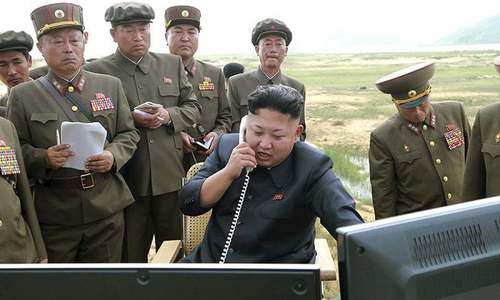
North Korea, however, overshadowed the carefully choreographed display in Xiamen by announcing on Sunday that it had detonated a powerful hydrogen bomb that it claims can fit on a long-range missile, dramatically raising the stakes in its standoff with the world.

The nuclear test was a slap in the face to Beijing, North Korea's longtime patron, and China's foreign ministry condemned it.
The summit includes Indian Prime Minister Narendra Modi, and presidents Vladimir Putin of Russia, Michel Temer of Brazil and South Africa's Jacob Zuma.
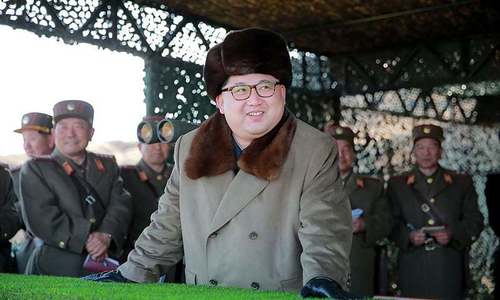
Pyongyang's actions marked the second time this year that unpredictable North Korean leader Kim Jong-Un timed use of his banned weapons programmes apparently to steal Xi's thunder on the world stage.
In May, Pyongyang conducted a missile test that embarrassed Xi just as he was hosting a large international summit to showcase his drive to promote global trade and infrastructure development.
Analysts have said such provocations by North Korea may be aimed at pressuring China to in turn push Washington to engage directly with Pyongyang.
The nuclear test and H-bomb claim could throw divisions over how to deal with Pyongyang into sharper relief.
Trump, who has previously threatened to rain “fire and fury” on North Korea if it made moves that raised the nuclear stakes, denounced the nuclear test as “very hostile and dangerous” and left open the possibility of a military response.
Russia and China, however, have pressed for a diplomatic solution.
Putin condemned the test, North Korea's sixth and most powerful, in a phone call with Japanese Prime Minister Shinzo Abe, according to the Kremlin.
But it said Putin reiterated the crisis “should be resolved only by political and diplomatic means”.
Xi opened the BRICS summit Monday with an address that avoided any mention of the brewing crisis. It was not clear whether BRICS would issue a joint statement on the nuclear issue. Both Xi and Putin are due to hold press conferences on Tuesday in Xiamen.
Family feud
BRICS was already struggling to paper over doubts about its own cohesion that have spiked as nuclear-armed China and India engaged in a protracted standoff over a disputed Himalayan region.
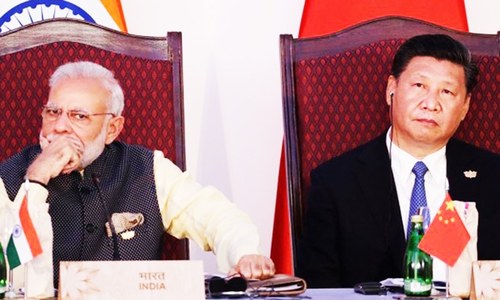
They backed off last week — perhaps to avoid ruining the summit — but the issue remains tense and eyes will be on the interplay between Modi and Xi in Xiamen.
BRICS nations comprise more than 40 per cent of humanity. The grouping came together a decade ago to advocate for the developing world's interests.
But policy analysts have increasingly questioned its usefulness, pointing out that its members have little in common and are too distracted by economic challenges of their own to achieve much as a group. Xi alluded to these questions in his speech on Sunday.
“Some people, seeing that emerging markets and developing countries have experienced growth setbacks, assert that BRICS countries are losing their lustre,” he said, admitting the group's members faced various “headwinds”.
The diverse group includes Communist-ruled China, authoritarian Russia and the democracies of India, Brazil and South Africa.
China's economic powerhouse is slowing while India seems on the rise.
Slumping commodity prices have hit hard the economies of exporters Russia, Brazil and South Africa, while Temer and Zuma face political turmoil at home.
Many economists view BRICS agreements to date as low-hanging fruit that take the bloc little closer to its goal of realigning the global economic and governance system.
Intra-BRICS trade also is heavily tilted in China's favour, fuelling complaints from fellow members.