An annual report by the US State Department has yielded a familiar verdict on our counterterrorism record: while some successes have been acknowledged, Pakistan has allowed externally focused militant networks to flourish.
But the significance of the latest assessment is twofold: it is the first report to be compiled by the Trump administration and it has come ahead of the unveiling of a revised US strategy in Afghanistan. Taken together, it suggests that the US is, indeed, drifting towards taking a harder line against Pakistan on this country’s alleged support for militancy.
Editorial: If the Afghan leadership remains closed to dialogue, there is little Pakistan can do
A rocky Pakistan-US relationship is not in the interest of either country, so perhaps both sides need to acknowledge the shortcomings in their respective approaches. Where the US is concerned, the almost casual disregard of Pakistan’s intensive counterterrorism and counter-insurgency efforts is a continuing problem.
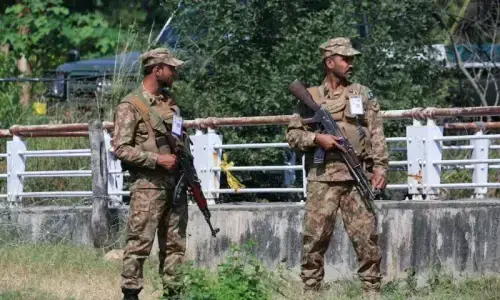
As Operation Khyber-IV in the Rajgal Valley of Khyber Agency has demonstrated, Pakistan is intensifying its operations against the militant Islamic State group in the region, an important goal that it has in common with Afghanistan and the current US administration. The unexpectedly fierce response by the Afghan defence ministry to Pakistan’s outreach to Afghanistan over the operation in Rajgal Valley is hardly conducive to regional cooperation in the fight against militancy.
Yet, Pakistan cannot simply disregard the US description of Pakistan’s efforts against militancy and terrorism. The specific language in the latest report about a number of Afghan Taliban and Haqqani network attacks inside Afghanistan being planned and launched from so-called safe havens here suggests a consensus by external intelligence agencies that Afghan-centric militants are able to operate with virtual impunity from Pakistani soil.
Whatever Pakistan’s rightful strategic interests in Afghanistan may be, there is simply no space for the continuation of a good Taliban/bad Taliban policy. The very fact that no sensible Pakistani strategist can publicly defend such a policy is telling — surely, no state ought to follow a policy that it cannot defend publicly and that runs counter to other efforts being made inside the country to re-establish security and stability.
Pakistan, as the US rightly acknowledges, has made some effort to nudge the Afghan Taliban towards dialogue with Kabul. The Afghan government and its security forces, assisted by the US, have clearly struggled to establish control over vast swathes of the country — Pakistan cannot be blamed for much of that. But neither should it be making the quest for peace and stability more difficult.
Published in Dawn, July 22nd, 2017