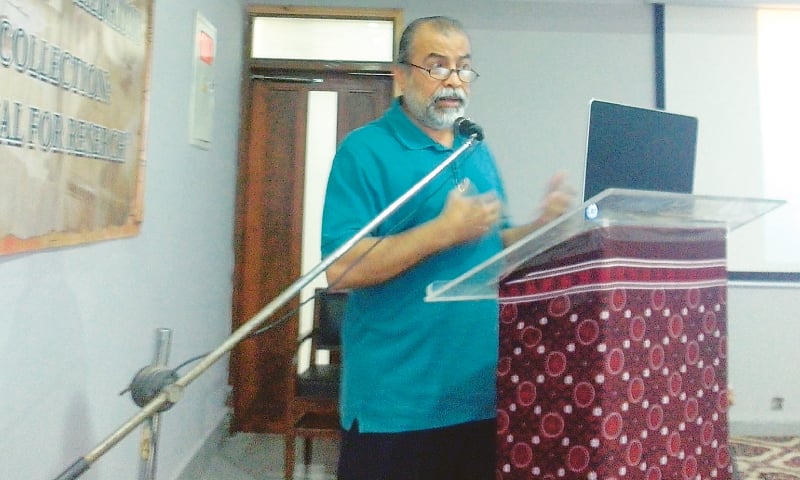
KARACHI: Wazir Mansion, believed by the government to be the birthplace of Quaid-i-Azam Mohammad Ali Jinnah, is not where he was actually born. Proof of this is in the records of the Sindh archives department, it was said at a seminar on the subject of ‘Archival collection: source material for research’ at the Sindh Archives Complex here on Tuesday.
According to Dr Kaleemullah Lashari, the Father of the Nation was born in a little house just behind Wazir Mansion where a commercial building stands today. But, the government acquired Wazir Mansion in 1953 and turned it into a national monument.
“A debate was started in the 1950s after looking at several primary school history textbooks that either mentioned Karachi or Jherruck as Jinnah’s birthplace,” said Dr Lashari. To finally settle the debate the chief minister of Sindh in Benazir Bhutto’s second government formed an inquiry commission to look into this. But before it could do that, the PPP government was toppled. Still, one wonders what kind of findings the inquiry commission would have come up with since its members never went to the archives,” he said. “But then scholar Rizwan Ahmed settled that debate by reminding that the Quaid himself had said that he was born in Karachi,” he added.
“As for his birthplace in Karachi, it is said it was Wazir Mansion. But if you study old records to settle Jinnah’s date of birth, you’ll see that the building constructed on the plot on which Wazir Mansion lies today was built on a land area of 24ft x 40ft while Wazir Mansion occupies 24ft x 46ft, which is six feet more,” he said while delving further into the matter by sharing old documents present in the archives.
He discovered that there were other buildings also on the same plot during the time such as a big building at the front where the owners lived with portions behind it. One of these portions was rented by Jinnah’s grandfather whose name was mentioned in the archives. Jinnah’s father also resided there with his family and that house faced another street. There are other documents including legal documents and a sale deed of the main house and the rest of the properties on that piece of land. The missing six feet from the old building turned out to be a platform at the front which was later regularised and included in the plot on which a new building now known as Wazir Mansion was built. “As for the actual birthplace of Jinnah, [it] is where you have a commercial building named Ali Plaza today,” the historian pointed out.
Earlier, during his talk, Dr Amin Lutfi said that the historian had a strong relationship with archives. He said that he had visited several archives in Pakistan and abroad including those in England, America and Africa “but credit goes to Sindh Archives for being able to preserve and categorise the material acquired while providing access to it all”.
He also lamented that despite this, people weren’t accessing them as they didn’t seem interested. “There is a need for proper training of historians here to make the presentation more interesting,” he added.
Former director of Sindh Archives and senior bureaucrat Iqbal Nafees Khan said that there were no short-cuts in research. “You need patience when going through archives,” he said, while adding that he had been to the British Library in the UK, too, where at closing time each day the people have to be coaxed to leave. He said that the Sindh Archives comprised a huge collection, including 12,000 manuscripts. They have also developed software with research options, some of which are also available online.
Prof Dr Abdul Hafiz Jamali, an academic and former director of Balochistan Archives, also stressed the importance of knowing how to use archives “to reconstruct our social history”.
He said that by studying archives in Balochistan he learnt how Gwadar, then under Omani rule, always served as an important port for trade with Mombasa, Zanzibar and Mozambique.
“It was during the colonial period that Karachi and Bombay emerged as the big harbours because of telegraph lines and railways,” he said. “[With] the change in trade patterns the labour centres also moved from there. That is how there are Makrani paras in Karachi today. The Makranis are also runaway slaves who had found refuge in and around Gwadar. I know all this by studying the archives in Balochistan. It’s all there,” he said.
Finally, in his concluding remarks, Syed Sardar Ali Shah, Minister for Culture, Tourism, Antiquities and Archives Department, said that the archives department was not taken very seriously until now.
“A lot has been done, a lot still needs to be done. We want to collect our records in the UK, India and Iran and bring them all here,” he said.
Director of Sindh Archives Abdul Aleem Lashari also spoke.
Published in Dawn, June 14th, 2017