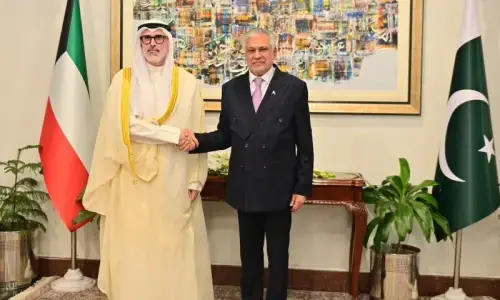
ONE strained bilateral relationship – with India – was not addressed, but another was. On the sidelines of the Shanghai Cooperation Organisation summit in Kazakhstan, Prime Minister Nawaz Sharif met Afghan President Ashraf Ghani and agreed to a revival of the moribund Quadrilateral Coordination Group to develop a verification mechanism for actions by Afghanistan and Pakistan against terrorists as demanded by the other side. The specific language used by the Foreign Office hints at continuing difficulties: “The two leaders agreed to use the Quadrilateral Coordination Group mechanism as well as bilateral channels to undertake specific actions against terrorist groups and to evolve, through mutual consultations, a mechanism to monitor and verify such actions.” Translation: the agreement in Kazakhstan is a tentative one, with both sides yet to agree on the specific steps that are to be taken and possibly verified by the other two QCG members, the US and China. Welcome then as any dialogue or potential cooperation between Afghanistan and Pakistan is, there is some way to go before the results can be achieved.
Perhaps a starting point would be for Afghanistan, Pakistan and the QCG to understand why previous attempts at cooperation against mutually identified terrorists have failed. Is it because neither the Afghan nor Pakistani side has taken the exercise seriously? Or do they not trust the other to do what is required? Third-party verification can only help if the core parties are committed to making a process work. Moreover, Kabul can sometimes have conflicting demands: nudging the Afghan Taliban to the dialogue table is unlikely to work if Afghanistan is simultaneously demanding of Pakistan that the Taliban leadership be put under extreme pressure or be handed over to the Afghan government. If there is an obvious trust-building, potential area of cooperation it is against the militant Islamic State group, a threat to all members of the QCG. Whatever is agreed, the process needs to move forward quickly. History suggests that debating modalities and frameworks can become a way of delaying verifiable action. Afghanistan and Pakistan are publicly committed to peace. They can surely find a way to take the right steps in that direction.
Published in Dawn, June 12th, 2017