CPEC must not be politicised, says Sharif
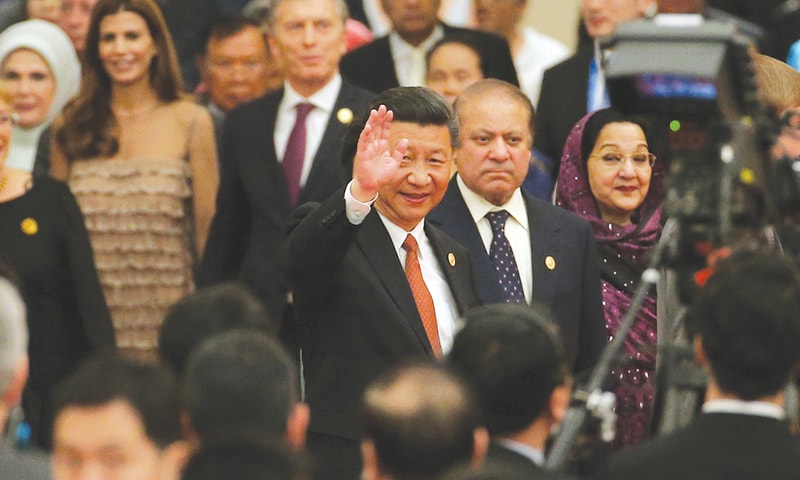
BEIJING: Prime Minister Nawaz Sharif said here on Sunday the China-Pakistan Economic Corridor (CPEC) was open to all countries in the region and it “must not be politicised” as China’s President Xi Jinping opened the Belt and Road Forum for International Cooperation by pledging $124 billion for his ambitious new Silk Road plan “to forge a path of peace, inclusiveness and free trade”.
Speaking at the plenary session of the two-day forum, themed “Cooperation for Common Prosperity”, the prime minister called for building a peaceful, connected and caring neighbourhood by shunning mutual differences.
“It is time we transcend our differences, resolve conflicts through dialogue and diplomacy and leave a legacy of peace for future generations,” he said at the gathering, with 29 heads of states and governments and 1,500 delegates in attendance.
Prime Minister Sharif said peace and development went hand in hand, and nothing could pave the path to peace and security more than economic development achieved through regional collaboration.
President Xi pledges $124bn for his ambitious new Silk Road plan
“The One Belt, One Road (OBOR) signifies that geo-economics must take precedence over geo-politics, and that the centre of gravity should shift from conflict to cooperation,” he said.
Mr Sharif emphasised that OBOR negated the logic of polarisation and rejected the encirclement of any country.
Earlier, opening the forum, President Xi Jinping called for abandonment of old models based on rivalry and diplomatic power games.
He used the summit, attended by leaders and top officials from around the world, to bolster China’s global leadership ambitions as US President Donald Trump promotes “America First” and questions existing global free trade deals.
“We should build an open platform of cooperation and uphold and grow an open world economy,” President Xi said.
China has touted what it formally calls the Belt and Road initiative as a new way to boost global development since President Xi unveiled the plan in 2013, aiming to expand links between Asia, Africa, Europe and beyond, underpinned by billions of dollars in infrastructure investment.
“We must promote the multilateral trade system, establishment of free trade regions and the facilitation of free trade,” the Chinese president said.
Massive funding boost
President Xi pledged a major funding boost to the new Silk Road, including an extra 100 billion yuan ($14.50 billion) into the existing Silk Road Fund, 380 billion yuan in loans from two policy banks and 60 billion yuan in aid to developing countries and international bodies in nations along the new trade routes.
The heads of the United Nations, the International Monetary Fund and the World Bank are also attending the gathering.
Britain’s Chancellor of the Exchequer (finance minister) told the summit his country was a “natural partner” in the new Silk Road.
India refused to send an official delegation to Beijing, reflecting displeasure with China for developing a $57 billion trade corridor through Pakistan that also crosses the disputed territory of Kashmir.
“No country can accept a project that ignores its core concerns on sovereignty and territorial integrity,” said Indian foreign ministry spokesman Gopal Baglay, adding that there were concerns about host countries taking on “unsustainable debt”.
China plans to import products worth $2 trillion from countries participating in its Belt and Road initiative over the next five years, Commerce Minister Zhong Shan said.
But some Western diplomats have expressed unease about both the summit and the plan as a whole, seeing it as an attempt to promote Chinese influence globally. They are also concerned about transparency and access for foreign firms to the scheme.
“China is willing to share its development experience with all countries. We will not interfere in other countries’ internal affairs. We will not export our social system and development model, and will not impose our views on others,” President Xi said.
“We need joint efforts among Belt and Road countries to boost financing cooperation,” said Zhou Xiaochuan, the governor of China’s central bank. “To sustain the projects, Belt and Road nations should allow companies to play a key role as government resources are limited.”
At the forum, finance ministers from 27 countries, including China, approved principles that will guide project financing along the new Silk Road.
Germany, which was not among the countries that approved the financing guidelines, said its firms were willing to support the Belt and Road initiative, but more transparency was needed.
China has rejected criticisms of the initiative and the summit, saying the scheme is open to all, is a win-win, and aimed only at promoting prosperity.
Some of China’s most reliable allies and partners are at the forum, including Russian President Vladimir Putin. There are also several European leaders attending, including the prime ministers of Spain, Italy, Greece and Hungary.
Published in Dawn, May 15th, 2017