57
57

LONDON: The UK police are in the process of transferring nearly half a million pounds to Altaf Hussain, the Muttahida Qaumi Movement and Karachi businessman Sarfraz Merchant.
The money was originally seized in the course of a money laundering investigation by the Metropolitan Police’s National Terrorist Financial Investigation Unit. The investigation was dropped last year after the Crown Prosecution Service said there was insufficient evidence to go ahead with a trial.
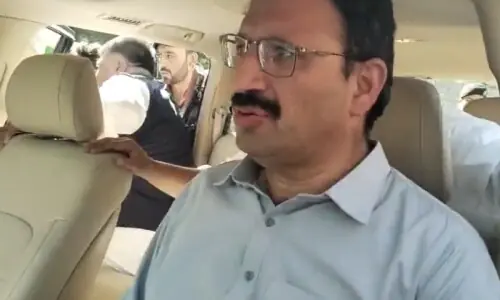
Having already had £24,000 transferred to his bank account, on Tuesday, Mr Merchant was handed around £5,000 worth of cash in the form of dirhams and Pakistani rupees. Two plain-clothes police officers gave him the money in a car park in West London as Mr Merchant sat in his £60,000 Range Rover.
“It is a success,” said Mr Merchant after getting the cash. “My money was legitimate.”
In the course of their investigation into the murder of 2010 senior MQM leader Imran Farooq, the UK police found £29,000 in Mr Merchant’s London apartment, £167,525.92 in the MQM’s offices in London and a further £289,785.32 in Altaf Hussain’s home. All those funds are now being returned.
Banking documents revealed that Mr Merchant had made substantial money transfers to the MQM. Mr Merchant told the police that money had been his own and was freely given to the MQM.
The return of the money to Mr Merchant and the MQM marks a humiliating climbdown for the UK police. Sources close to the police investigation always insisted that they would not return the MQM’s cash. Asset confiscations require a lower burden of proof than money laundering charges. But it turns out the UK authorities have been unable to meet even that lesser threshold.
The police said that during the course of their money laundering investigation six people had been arrested, 11 others were interviewed under caution and nine premises were searched. Despite all that work, the police said last year: “there is not a realistic prospect of a successful prosecution under UK law, therefore the investigation is now complete and no further action will be taken.”
Frustrated by the lack of progress in the UK, the Pakistan authorities last year formed a Joint Investigation Team to look at Mr Merchant’s claims of financial links between RAW and the MQM.
Mr Merchant said he still wanted to expose that issue. “I am going to pursue the issue regarding RAW funding because it is my country that is suffering,” he said. Mr Merchant said the documents given to him by the UK police showed there was such funding.
The MQM have denied being funded by RAW. India described claims that it funded the MQM or trained its militants as completely baseless.
UK-based lawyers say one of the reasons the money laundering case failed was the UK authorities’ reluctance to use terrorism legislation as opposed to the Proceeds of Crimes Act. Although the US describes the MQM as a Tier 3 terrorist organisation, neither the UK nor Pakistan has made a similar designation.
The Proceeds of Crimes act requires the UK authorities to prove the criminal provenance of the MQM’s funds. Since the UK authorities have no investigative powers in Karachi, it is difficult for them to establish whether there has been criminal activity there without the cooperation of the Pakistan authorities.
The MQM always maintained that its funds were legitimate and came in the form of donations from businessmen in the city.
At the time the money laundering investigation was dropped Mr Merchant said even his own lawyers were surprised by the decision. “While I am delighted to have been cleared there appears to have been political interference with the UK’s police investigation,” he said at the time.
Mr Merchant said he will now seek to recover the money he has spent on lawyers in the UK as he tried to defend his name. “I will go for action against the police,” he said, adding that his legal costs had been over £1 million.
The UK authorities are still investigating whether some speeches by Mr Hussain amount to hate speech. A previous hate speech inquiry was dropped in 2014 because of fears that the translation of the original Urdu speeches could be contested in the courts. The police are now assessing whether more recent speeches — not least the August 22 speech — contained not just hate speech but also incitement to violence.
Published in Dawn, March 22nd, 2017