5
5
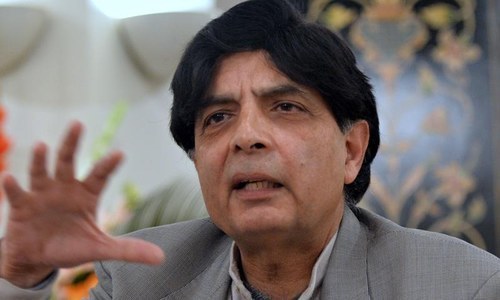
ISLAMABAD: Interior Minister Chaudhry Nisar Ali Khan told the Senate on Monday that a law was being prepared to stop leaders of proscribed organisations from taking part in elections.
Winding up the discussion on implications of a statement made by him in the Senate on Jan 10 making a distinction between banned terrorist outfits and proscribed sectarian organisations, he said the existing law did not prevent outlawed organisations from contesting elections and holding meetings with government functionaries and civil servants.
The minister regretted that his remarks made in the house had been misconstrued and criticised outside the parliament.
He said he had never talked of giving space to banned sectarian organisations or showing leniency to them. He said he had also not said they were lesser terrorists.
No racial profiling of Pakhtuns under way, Chaudhry Nisar tells Senate
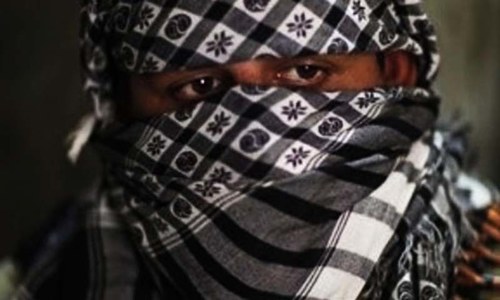
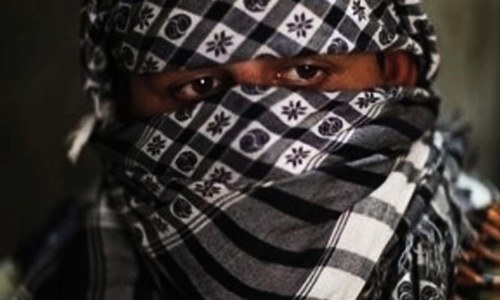
However, he said while there was no room for terrorist organisations to operate in the country, the case of proscribed organisations was different in a sense that many of their followers and activists had no case registered against them. Chaudhry Nisar said he had proposed legislation in this context.
He said almost all terrorist attacks in the country in the pre-operation Zarb-i-Azb period were engineered and masterminded in North Waziristan. The situation is entirely different now and no terrorist organisation has its headquarters in Pakistan and they are operating from across the border.
He rejected criticism over his ‘inadvertent’ meeting with the head of an outlawed organisation as part of a delegation led by Defence of Pakistan Council chief Maulana Samiul Haq and said the issue of blocked computerised national identity cards (CNICs) was discussed in the meeting. Without naming Maulana Ahmad Ludhianvi, he said the person had contested 2013 general elections but nobody objected to it.
He said an election tribunal had de-seated the Pakistan Muslim League-N lawmaker from Jhang and declared that person as returned candidate in his place, followed by a legal battle and a stay by the apex court.
Chaudhry Nisar said he had documentary evidence of meetings between leaders of banned organisations and former president and federal ministers in the past.
Taking the objections over the meeting as something positive in a sense, he said it was indicative of awareness and consciousness which the incumbent government had given to people. In the past, he said, even it was not known how many proscribed organisations were there in the country.
Racial profiling
Earlier the interior minister told the National Assembly that no racial profiling of Pakhtun people was under way in parts of the country. He said there was a procedure under which CNICs had been blocked and made it clear that no foreign national could be allowed to keep fake CNICs and passports.
He disclosed that Mullah Mansour was not the only (Afghan) militant leader to have acquired Pakistani CNIC and passport and said there was a long list (of such persons). However, he avoided sharing any detail.
He provided the province and language-wise break-up of blocked CNICs for the first time, which clearly showed that the Pakhtun people were the major sufferers.
According to him, of the total 344,597 blocked CNICs, 217,007 belonged to Pushto-speaking people, followed by 41,456 Urdu-speaking persons, 29,510 Punjabi-speaking persons, 8,426 Balochi-speaking persons and 7,037 Sindhi-speaking persons.
The breakup of other linguistic groups was: 5,297 Balti-speaking persons, 4,995 Seraiki-speaking persons, 3,838 Brahvi-speaking and 3,493 Hindko speaking persons. A large number of 23,538 persons belonged to miscellaneous ethnic groups, including foreigners. The data shows that the highest number of 106,020 blocked CNICs was issued in Khyber Pakhtunkhwa followed by 85,923 in Sindh, 60,408 in Balochistan, 61,304 in Punjab and 12,031 in the Federally Administered Tribal Areas.
Published in Dawn, March 21st, 2017