GENEVA: All Syrian sides that fought in the battle for Aleppo committed war crimes and the deal to evacuate civilians following the rebel defeat was a “crime of forced displacement’, a UN probe said Wednesday.
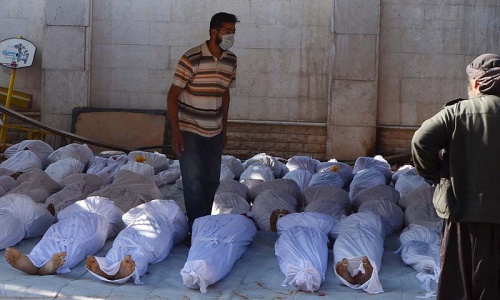
The United Nations Commission of Inquiry [COI] for Syria documented violations including chemical attacks and civilian executions perpetrated during the Damascus regime’s five-month siege of eastern Aleppo, which had been a key opposition stronghold.
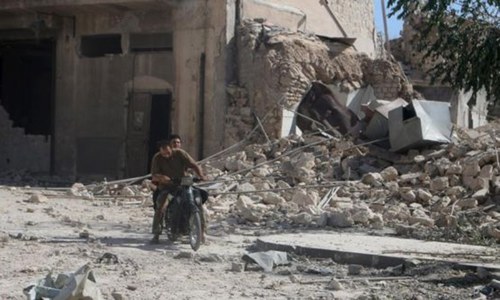
From July 21, 2016 to December 22, when government troops recaptured the city, the Syrian air force and its Russian ally “conducted daily air strikes” on Aleppo, the COI said.
There is conclusive evidence that Syrian aircraft dropped “toxic industrial chemicals, including chlorine”, but there is no information indicating the Russians used chemical weapons, the report said.
The aerial bombardments saw hospitals, markets and residential buildings repeatedly hit.
In a major new finding, investigators also said there was proof that Damascus was responsible for September 19 air strikes in Aleppo province that deliberately targeted a humanitarian convoy, killing at least 10 aid workers.
President Bashar al-Assad’s government has fiercely denied responsibility for the bombardment in Urem al-Kubra and a separate UN probe in December said it was impossible to establish blame.
But after analysing satellite images, forensic evidence and other material the COI determined that “Syrian air forces targeted [the] humanitarian aid convoy”.
The evidence “strongly” suggests that the attack — which forced relief workers to pause deliveries of life saving supplies — was “meticulously planned and ruthlessly carried out” to hinder humanitarian work, according to the inquiry.
The Syria COI, set up in 2011 to investigate the most serious crimes committed in the country’s civil war, was asked in October to specifically probe the battle for Aleppo.
The latest findings were released in Geneva, where the UN was also hosting regime and opposition delegations for faltering peace talks.
Civilians had ‘no option’
Investigators described Aleppo as a scene of “unrelenting violence” in which civilians in the rebel-held east and government controlled west fell “victim to war crimes committed by all parties.” The disparate rebel factions in Aleppo, including former Al Qaeda affiliate Fatah al-Sham Front, shelled civilians in western Aleppo and indiscriminately fired with no clear military target, the COI said.
As the opposition resistance was crumbling and civilians tried to escape, “some armed groups violently prevented them and used them as human shields”, the inquiry further found.
The evacuation deal agreed between warring parties that effectively marked regime’s victory allowed for civilians to move into western Aleppo or be transported to Idlib, an opposition stronghold in Syria’s northwest.
Those evacuations, which were observed by UN staff and the International Committee of the Red Cross, left civilians with “no option to remain”, the COI said.
“Such agreements amount to the war crime of forced displacement of the civilian population”, UN investigators concluded, stressing that the deal in Aleppo was made “for strategic reasons - and not for the security of civilians.”
Reprisals
The Aleppo fight was among the most horrifying episodes in a Syria’s six-year war that has claimed more than 310,000 lives. Medical charity Doctors Without Borders described the city’s east as a “kill box.” The battle began to decisively turn in the regime’s favour in late November, setting off a series of reprisal killings perpetrated by both Syrian soldiers and allied fighters.
“These included cases of Syrian soldiers killing their own relatives,” who backed the opposition and pro-government forces executing the wife and daughter of a rebel commander as they tried to enter western Aleppo, the report said.
Assad’s forces have reportedly been backed by Lebanese, Iranian and Iraqi forces among others, but the COI did not decisively link individual militias to specific atrocities.
Published in Dawn, March 2nd, 2017