RIYADH: Six months after Saudi Arabia said its war in Yemen was winding down, air strikes are again pounding rebels and rockets flying across the border, with no end to the conflict in sight.
Facing criticism of its bombing campaign and a budget crunch from low oil prices, Riyadh is keen to bring an end to the intervention it launched last year against Shia Houthi rebels and their allies, analysts say.
But the suspension in early August of UN-brokered peace talks in Kuwait, after three months without any headway, has instead led to a major increase in violence.
“Both sides now are trying to prove they are better in war than peace,” said Farea al-Muslimi, a Yemeni specialist and visiting scholar at the Carnegie Middle East Centre.
The Saudi-led Arab coalition launched the air raids in March last year, later sending in ground forces, to support the internationally recognised government of President Abedrabbo Mansour Hadi after the rebels overran much of Yemen.
Riyadh accuses the Houthis, allied with troops loyal to ex-president Ali Abdullah Saleh, of working on behalf of its arch-rival Iran.
Coalition warplanes are also supporting pro-government forces against Al Qaeda militants who have exploited Yemen’s power vacuum to expand their presence in the country’s south and southeast.
A year into the intervention, spokesman Brigadier General Ahmed Assiri told AFP that coalition forces were “in the end of the major combat phase”.
A relative lull in the fighting followed, but in late July the most serious fighting for months along the border killed 12 Saudi soldiers.
The talks in Kuwait were suspended a few days later and the coalition resumed intense strikes on Sanaa and other rebel-held areas.
Rebel attacks also intensified. On Tuesday Saudi Arabia suffered its heaviest civilian losses of the conflict when seven died in a rebel rocket strike on the border city of Najran.
“This looks to be a long, continuing war,” said Anthony Cordesman of the Centre for Strategic and International Studies in Washington.
Criticism of civilian deaths
Saudi Arabia has faced repeated criticism from rights groups over civilian casualties.
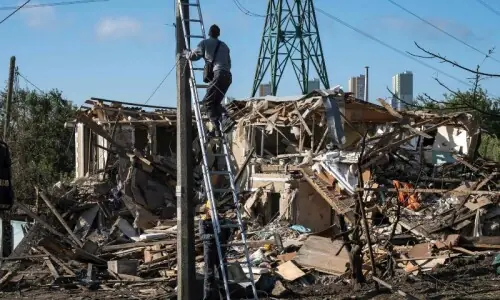
Deadly air raids on a school and a hospital over the last few days again raised questions about coalition procedures and added to a civilian death toll which the UN puts at more than 3,700 since the intervention began.
The coalition has launched investigations into both incidents.
The costly operation also comes despite austerity measures and efforts to reorient the kingdom’s economy after a deficit-inducing collapse in oil prices.
But analysts say withdrawing from such a complicated conflict is not easy.
“There are so many different factions and elements involved,” Cordesman said, noting divisions among both the Houthi-Saleh forces and the government.
That has made peace efforts extremely difficult, analysts say.
A source closely following the conflict, speaking on condition of anonymity due to the sensitivity of his position, said the Saudis have been “working very hard” towards a lasting peace and political transition in Yemen.
But when the Houthis and their allies on Aug 6 appointed a council to govern Yemen, Riyadh had little choice but to respond.
“That was [an] unexpected move, for the Saudis especially,” Muslimi said, adding that Riyadh could not tolerate the threat to the “legitimacy” of Hadi’s government.
Adam Baron, a visiting fellow and Yemen specialist at the European Council on Foreign Relations, said Riyadh still feels it can handle the war “at least for the time being”.
Since peace talks collapsed, local forces backed by the coalition “appear to have made some gains” around Taez, in the southwest, and Nihm, northeast of Sanaa, Baron said.
“The key at the moment is their ability to put pressure on Sanaa itself from the Nihm front,” he said.
The Houthis would be hard to dislodge. Northern Yemen is their traditional stronghold. They fought six wars against the central government between 2004 and 2010.
“It, at this point, seems to be a war of attrition,” Cordesman said.—AFP
Published in Dawn, August 18th, 2016