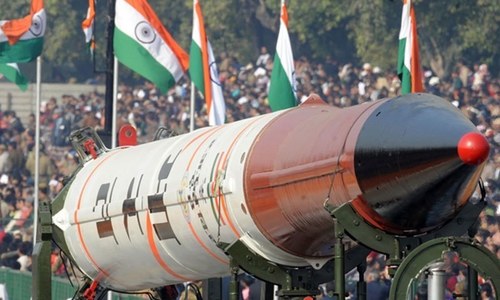
ISLAMABAD: A nuclear expert from Moscow says despite heavy investments in developing anti-ballistic missile systems, India may not be able to fully defend itself in a conflict from strikes by Pakistani missiles.
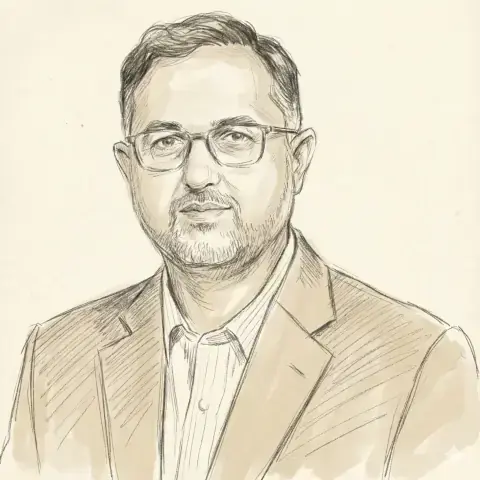
“Even in 10 years and with the huge budgets that India plans to spend on the development of nuclear weapons and capabilities, it is difficult to imagine it will be able to defend its territory from possible strikes from Pakistan in case of conflict,” said Petr Topychkanov, a senior researcher at the Carnegie Moscow Centre’s Non-Proliferation Programme.
Talking about ‘Non-Proliferation and Strategic Stability in South Asia: A Russian Perspective’ at the Strategic Vision Institute (SIV) which is an Islamabad-based think tank specialising in nuclear issues, Mr Topychkanov said that despite largescale cooperation between India and Israel for the development of a ballistic missile defence system and Indian efforts for acquiring S-400 defence systems from Russia, “India is very far from developing any system that could effectively defend itself from a Pakistani missile”.
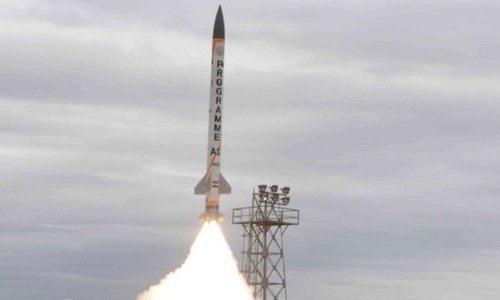
Last Sunday India tested an Advanced Air Defence (AAD) interceptor missile and is working on developing a multi-layer ballistic missile defence system and Pakistan has expressed concerns over the test.
It is feared that the development of anti-ballistic missile systems may give Indian strategists a false sense of security when contemplating military action against Pakistan with the belief that they can take care of an incoming missile.
The possession of such a system could also increase pre-emption tendencies among Indian military planners. Pakistan experts also feel that with the short missile flight time between India and Pakistan, it will be impossible for intercepting incoming missiles.
Talking about India’s candidature for the Nuclear Suppliers Group (NSG) Mr Topychkanov said the world will be cautious about India.
“The nuclear waiver given to Indian became a very important part of the lesson for the international community because Delhi did not give a lot in exchange, it didn’t change policies and approaches,” he said.
When it was getting the waiver from NSG following an India-US Civilian Nuclear Agreement, India had committed that it will separate its civilian and military nuclear facilities in a phased manner, place civil nuclear facilities under International Atomic Energy Agency (IAEA) safeguards, sign and adhere to IAEA’s additional protocol, continue its unilateral moratorium on nuclear testing, work with the US for the conclusion of the Fissile Material Cut-off Treaty (FMCT), refrain from the transfer of enrichment and reprocessing technology to states that do not have them and support international efforts to limit their spread, introduce comprehensive export control legislation to secure nuclear material and adhere to the Missile Technology Control Regime (MTCR) and NSG guidelines.
Mr Topychkanov said it would not be the same this time because India will have to show “serious progress in relations with IAEA, UN and the international nuclear community”.
Meanwhile, also claiming to have sound credentials for becoming an NSG member, Pakistan won rare acknowledgement from the US for its “significant efforts to harmonise its strategic trade controls with those of the NSG and other multilateral export control regimes” on Tuesday at a meeting of the Pak-US Security, Strategic Stability, and Nonproliferation (SSS&NP) Working Group.
Talking about Russia’s policy for strategic stability in South Asia, the Mr Topychkanov said Moscow is interested in regional strategic stability and is working on avoiding crisis in the area.
He said despite longstanding strategic partnership with India, Russia was developing relations with both Islamabad and Delhi.
SVI President Dr Zafar Iqbal Cheema expressed concern about the deteriorating strategic balance in the region because of India’s acquisition of conventional and nuclear weapons and said such developments seriously impact Pakistan’s interests.
Published in Dawn, May 19th, 2016