4
4

CALM prevailed in the local currency market last week. Though demand for dollar existed, the market witnessed lacklustre activity. The rupee traded range-bound versus the dollar and euro amid seesaw movements.
Fresh foreign funds inflow supported the local currency, but dollar’s strength against other major currencies overseas capped the rupee’s gain. The central bank kept providing dollars to commercial banks for their customers’ import payments that resisted the rupee from falling sharply on the interbank market. Analysts expect the local currency is likely to remain slightly under pressure due to an increase in importers demand for the dollars.
On the interbank market, the rupee escalated in the range of Rs104.68/70 and Rs104.79/81 against the dollar last week. The rupee suffered eight paisas loss against the dollar in the first trading session before slipping to Rs104.68 and Rs104.70 from the last closing at Rs104.60 and Rs104.62 on initial month-end dollar demand from importers.
The rupee is likely to remain slightly under pressure due to an increase in importers demand for dollars
The parity continued its downslide for the second straight day as the rupee extended its overnight weakness posting seven and nine paisas loss on the buying and selling counters at Rs104.75 and Rs104.79.
Fresh selling of dollars by banks and exporters amid dollar weakness in the overseas market slightly boosted the rupee value against the dollar, turning it positive in the third trading session at Rs104.73 and Rs104.76.
In the fourth trading session the dollar managed to bounce back and hit the week’s highest level at Rs104.79 and Rs104.81. In the last trading session, the rupee picked up three paisas on the buying and four paisas on the selling counters against the dollar. It closed the week at Rs104.76 and Rs104.77. During the week, however, the dollar managed to gain up to 16 paisas against the rupee in the interbank dealings on a week-on-week basis.
In the open market, the rupee/dollar parity maintained a stable trend since the beginning of March. The rupee did not show any change against the dollar last week. The parity traded flat at Rs106.10 and Rs106.30 in the four trading sessions, unchanged over the prior weekend’s level.
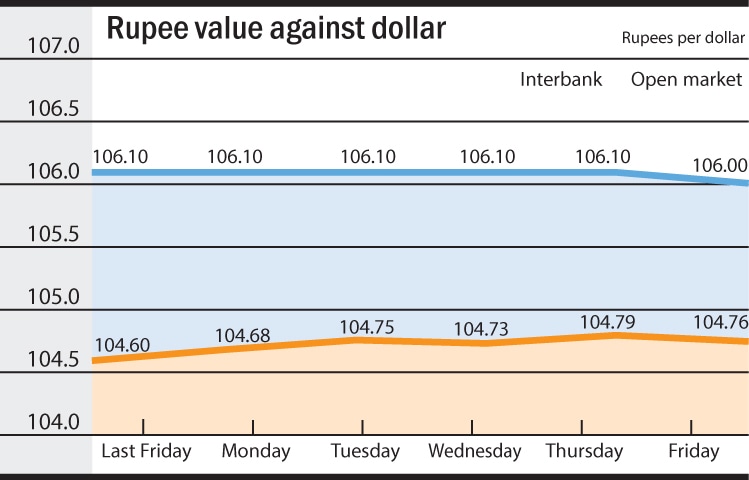
However, in the last trading session, the rupee posted 10 paisas gain, ending the week in plus at Rs106.00 and Rs106.20.
Against euro, the rupee showed firm trend, trading range-bound last week. It commenced the week with a 50 paisas gain in the first trading session and traded at Rs115.50 and Rs116.50 against the prior weekend’s Rs116.00 and Rs117.00 after the euro sank half a per cent against the dollar in overseas trade.
As a result of last session losses, the rupee still managed to appreciate by 20 paisas on a week-on-week basis, trading in narrow ranges between Rs115.00/116.00 and Rs115.80/Rs116.80.
Published in Dawn, Business & Finance weekly, March 7th, 2016