IN a recent meeting held at a university to discuss the curriculum for the teachers’ education programme, it was hotly debated whether or not Urdu was a ‘lashkari zaban’ or the so-called ‘camp-language’.
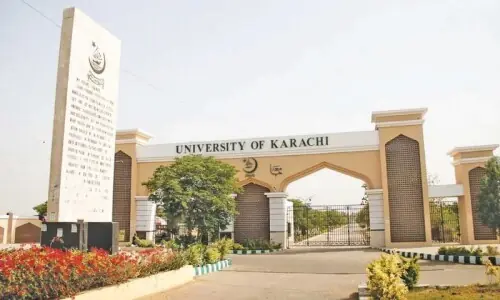
Some professors from Karachi University’s Urdu department objected to the incorrect, age-old theory being taught to the new teachers. But some college teachers insisted that Urdu was a camp-language and the theory was valid, hence the new curriculum must not exclude it. Little did they know about the fact that the ‘camp-language’ theory had been proven wrong some 90 years ago by linguists and researchers.
But it is a misconception so widespread that it is taken as a universal truth. Ask anybody, even well-educated, about the origin of the Urdu language and the pat answer would be “of course, it is a lashkari zaban”. Even some academics teaching at the college level are so naïve that they believe a new language can be formed by mixing the words from different languages. Though Max Muller, the well-known German linguist, has clearly said that no two languages can give birth to a new, third one.
There have been a myriad of theories of the origin of the Urdu language. But most of what the early theorists said was based on presumptions rather than the linguistic research. Mir Amman, one of the pioneers of the so-called ‘camp-language’ theory, said that Urdu was a mixture of several languages such as Persian, Arabic, Sanskrit and Turkish. Known as ‘lashkari zaban’ (or camp-language) theory, it surmises that Urdu was born in the Mughal army camps where the speakers of different languages used the ‘new’ language to communicate among themselves, as the Mughal armies comprised of the soldiers from different linguistic regions. Other writers who somehow agreed with the notion and echoed the theory include Sir Syed Ahmed Khan, Imam Bakhsh Sehbai and Muhammad Husain Azad.
The theory is incorrect because the family of a language is decided on the basis of its syntactical and morphological structure and not on its vocabulary, as words travel to different regions and are absorbed into other languages quite easily. And the structure of Urdu shows it has its roots in Vedic dialects; so it is purely a local, sub-continental language with a huge vocabulary from Arabic, Persian and some other languages.
Interestingly, Urdu existed much before than the arrival of the Mughals, who took India in the 16th century while Urdu’s earliest versions are as old as 11th and 12th centuries, albeit with different names. Urdu did not get its present name until the end of the 18th century. It was the writings of scholars such as Hafiz Mahmood Sherani and Dr Mohiuddin Qadri Zor that drove home the fact about Urdu. Dr Zor had proved in his dissertation written at London University in the 1920s that Urdu’s origin was to be found in a dialect spoken some 1,000 years ago in the region between North West India and Allahabad. Hafiz Mahmood Sherani too believed in the theory but he thought the dialect that gave birth to Urdu was a kind of Old Punjabi, spoken in and around Lahore. He felt that Muslim invaders from Afghanistan who had taken over Lahore and marched forward to Delhi in 1192-93 had taken the new language — based on the local dialect and some words from other languages — with them to Delhi, where it ultimately overshadowed the other dialects.
The theory that Urdu was born in Punjab gave birth to a chain of theories, with every region claiming to be the cradle of the language. So we had theories such as Urdu was born in Deccan, in Sindh, in South India, in Multan.
Muhammad Husain Azad had said in addition to repeating camp-language theory that Urdu had developed from Brij Bhasha, a dialect spoken around Agra and Mathura, UP. Some foreign scholars, such as Jules Bloch, Rudolf Hoernle and G.A. Grierson, had proffered their own theories.
Now this jungle of theories has been cleared by Prof Mirza Khalil Ahmed Baig in his two books. An Indian linguist, critic and academic, Dr Baig has taught linguistics at Aligarh Muslim University and has the honour of working with Dr Mas’ood Hasan Khan, Urdu’s towering personality who was first to say unambiguously that Urdu was born in and around Delhi and had its roots in dialects spoken there. Mas’ood Sahib also dispelled Sherani’s theory suggesting that Urdu was born in Punjab.
Dr Baig in his book Urdu ki lisani tashkeel has suggested that Shorseni Prakrit, a dialect spoken in the region of Shorsen in the Central India, developed into Shorseni Apbharansh, which in turn developed into Urdu. The book has run into four editions in India and Karachi’s Idara-i-Yadgar-i-Ghalib has published, with permission, the first Pakistani edition.
Dr Baig’s other book Urdu zaban ki tareekh is a collection of scholarly articles by different scholars. These articles, which include a few of his own too, bust several myths including the one about Urdu’s origin as a camp-language. Published by Aligarh’s Educational Book House, the book’s fourth edition has just appeared and the fifth one is on its way.
One hopes that our teachers would read at least these two books before debating the origin of Urdu at forums like university academic councils and board of studies so that their views are not spoofed at.
Published in Dawn, February 29th, 2016