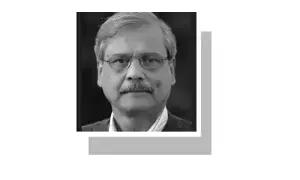
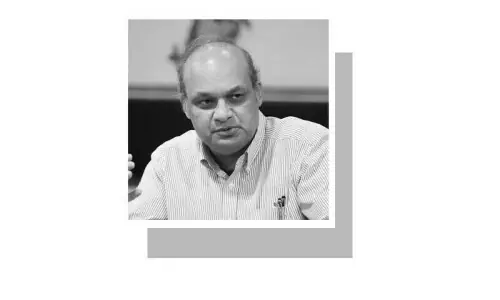
KARACHI: While discussing prospects for the ‘greater’ South Asian region, writer and analyst Shuja Nawaz said here on Friday that greater connectivity and interdependence between the states in the neighbourhood was the key to progress.
Mr Nawaz, who is a Distinguished Fellow at the Atlantic Council’s South Asia Centre in Washington and has authored Crossed Swords, an acclaimed book on the Pakistan Army, was delivering a lecture on ‘Regional challenges and opportunities for South Asia in the decades ahead’ at the Pakistan Institute of International Affairs.
Quoting Maleeha Lodhi, currently Pakistan’s Permanent Representative to the United Nations, he said Pakistan was one of the “most over-diagnosed countries in the world”.
Offering what he termed a ‘futurescape’ of the region, which he said should also include Iran and Central Asia as ‘greater South Asia’, Mr Nawaz said that to thrive, it would have to opt for connectivity and interdependence.
Mr Nawaz said he was not offering predictions but “scenarios” about the major factors likely to affect South Asia in the next two decades. “Economics will be at the heart of development and change” while good governance was also key, he said.
Discussing the main trends, the analyst said rapid urbanisation would play a major role, as most megacities were found in South Asia. He said that although many cities in the region were larger than some countries in Europe, “are [they] being managed like a country?”
He also described South Asia’s cities as “conflict zones” where disparities were evident and growth was uneven.
Mr Nawaz said the “Shia-Sunni squabble” emanating in the Middle East would spread because not enough forces were willing to counter sectarianism. He said communal strife would affect migrant workers heading to the Gulf region, while it was also true that Middle Eastern economies were slowing down.
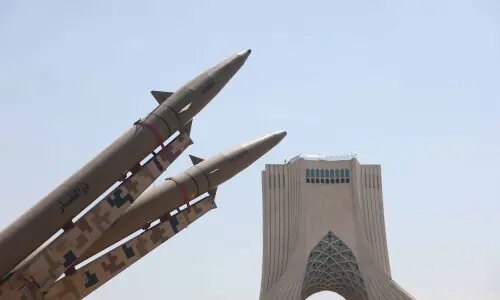
He said another area of concern was nuclear proliferation and there was unrest in the Gulf because of the recent Iranian nuclear deal. He said that although “nobody has facts [and it is] all speculation”, states in the region could possibly look for a nuclear umbrella and that “India and Pakistan will be asked to provide nuclear capacity”.
The writer observed that South Asia would also have to prepare for natural calamities such as earthquakes, floods as well as El Nino. He added that South Asian cities were not equipped to deal with rapid change and that religion, caste and ethnic barriers stood in the way of consensus.
Mr Nawaz said that “centrifugal forces” were likely to affect the “political map of the region. Don’t assume that countries that exist today will exist 30, 50 years from now, because of what we do and what we don’t do”.
He also suggested that “[we should] see if a different map of Pakistan — province-wise — can be created”.
He said the “shadow economy” was huge in this region, with estimates that 30 per cent or more of the economy here was “under the table”.
While discussing “centripetal forces”, Mr Nawaz said the China-Pakistan Economic Corridor was an “opportunity”, provided the western route was developed first. He said a “tributary to CPEC” should also be considered, linking Afghanistan to Central Asia. “This can create a perfect storm, a good storm.”
He was also of the opinion that climate change, the environment and water issues should be looked at through a regional lens rather than through strictly national outlooks.
Published in Dawn, February 20th, 2016