

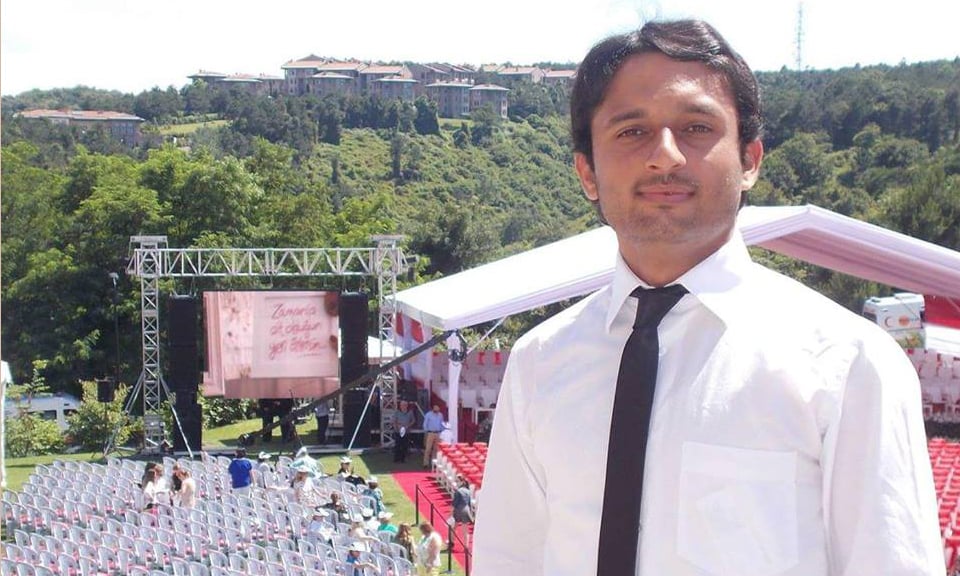
QUETTA: As the story of one of the world’s most influential scientific discovery unfolds, it comes to the forefront that not one, but two Pakistanis were part of the various research teams which contributed to the discovery of gravitational waves.
A young researcher from Quetta, Imran Khan, currently pursuing his PhD at Gran Sasso Science Institute (GSSI) in Italy, was one of the co-authors of the Physical Review Letter (PRL) paper, submitted to the LIGO Scientific Collaboration at the helm of this discovery.
“It was great to get selected among hundreds of applicants for the Marie Curie initial training network programme ‘GraWIToN’ to become part of the European team involved with the discovery of gravitational waves,” Imran Khan told Dawn.com.
The 25-year-old researcher, whose father is a retired armed forces member, hails from a middle-class family residing in Quetta.
The news of Karachi-born MIT professor who assisted the team of scientists in the historic detection of gravitational waves is already receiving tremendous viral jubilation. Nergis Mavalvala is a member of the US-based LIGO Scientific Collaboration, and played a major part in the research which is dubbed the century's biggest finding by many.
Friends and relatives are showing up at Imran’s home in Quetta to celebrate his success. However, the family complained that the national media has ignored the success of the budding scientist.
"I want to work hard and contribute towards a better scientific society, in order to propagate a positive image of our country," Imran said.
"I am happy that my son did something positive for Pakistan," Imran’s father, Kafil Wara, told Dawn.com.
Imran added, "My mother is the inspiration behind my hard work. It’s her prayers which paved the way for me in achieving my career goals."
"I want him to return from Europe soon," his aged mother remarked.
Imran secured 892 marks in intermediate and then availed a scholarship from FAST Peshawar, to complete his Bachelors of Science (BS) in Telecommunication Engineering in 2011.
He was the offered a scholarship in MS Optoelectronics and Photonics Engineering by a Turkish institute in 2015.
Mr Imran Khan a PHD scholar in Italy and a Graduate of FAST Peshawar is the 2nd Pakistani that worked with a team of...
Posted by FAST NUCES on Saturday, 13 February 2016




























