1
1

The rupee traded almost stable amid minor changes against the dollar and euro last week after witnessing sharp volatility in 2015.
On the interbank market, the rupee resumed 2016 with a falling trend versus the dollar, amid range-bound trading. The rupee turned negative in the opening session of the last week due to buying pressure and posted 15 paisa loss before closing the session at Rs104.88 and Rs104.90. The rupee closed prior week on a positive note at Rs104.73 and Rs104.75.
As buying pressure existed on the second day, the rupee continued its downslide against the dollar posting fresh loss of four-paisa at Rs104.92 and Rs104.94.
The local currency managed to trim losses against euro last week
The rupee staged a moderate recovery against the dollar in the third trading session, picking up two paisa at Rs104.90 and Rs104.92. After a brief overnight calmer, the rupee once again turned shaky against the dollar and closed the fourth trading session at Rs104.92 and Rs104.95, following two-paisa loss on the buying counter and another three-paisa on the selling counter.
In the last trading session, the local currency made a minor correction on the buying counter where it inched down by one-paisa and retained its overnight rate unchanged on the selling counter. However, the week ended almost flat at Rs104.93 and Rs104.95.
During the week in review, the rupee lost 22 paisa in four sessions while gaining two-paisa in one session against the dollar on the buying counter. On the selling counter, however, it lost 22 paisa against the dollar in three sessions while it gained two-paisa in one session and traded unchanged in one session.
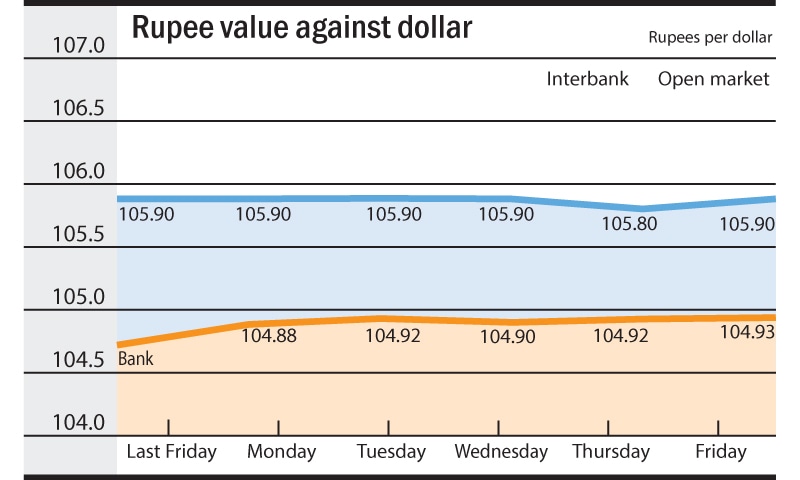
On week-on-week basis, however, the dollar gained 20 paisa against the rupee on the interbank market last week.
In the open market, no hectic trading activity was observed as calm prevailed for the second successive week in the absence of leading currency players.
Demand for dollars matched supplies. The week commenced on a stable note as the dollar traded flat at Rs105.90 and Rs106.10 in relation to the rupee in the first trading session, showing no change over the last closing levels.
Due to a significant fall in international oil prices, a slight increase in dollar demand was observed in the last trading session. Consequently, the rupee trimmed its overnight gains against the dollar and posted 10 paisa loss in the fifth trading session, closing the week at Rs105.90 and Rs106.10, unchanged over the prior week close.
During the week in review, the dollar in the open market traded unchanged against the rupee on the buying counter in three sessions while gaining and losing 10 paisa each in the remaining two sessions.
On the selling counter, the rupee shed 15 paisa in two sessions and also gained 15 paisa in two sessions while trading unchanged in one session.
Published in Dawn, Business & Finance weekly, January 11th, 2016