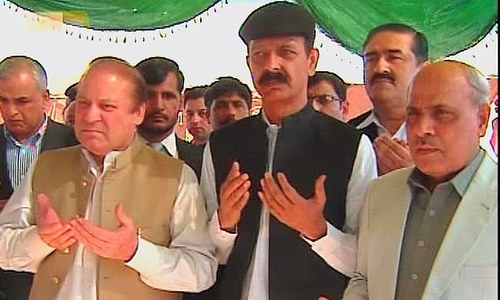
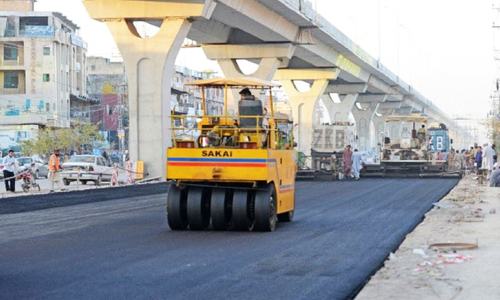
KHANEWAL: Prime Minister Nawaz Sharif inaugurated the Khanewal-Multan section of the Multan-Faisalabad motorway on Saturday, reported Radio Pakistan.
The prime minister was received by Governor Punjab Muhammad Rafique Rajwana and Federal Minister for Food Security and Research Sikandar Hayat Khan Bosan, who briefed him on the project. The M-4 section will be 56-km-long, and will run in four lanes.
The Khanewal-Multan section of the motorway is estimated at Rs13billion and will include four interchanges, seventeen bridges and twenty eight subways.
The M-4 section is part of the bigger Karachi-Lahore motorway, which has been planned for four phases. In the first phase, a 139-km-long six-lane motorway between Karachi and Hyderabad will replace the Superhighway.
The second phase will link Hyderabad and Sukkur, and the third phase will link Sukkar and Multan. The last phase will bring Multan and Lahore closer.
Besides the Karachi-Lahore motorway, there is a plan for the construction of a motorway from Khunjerab to Gwadar and from Peshawar to Kabul to link central Asian countries and facilitate trade routes.
The construction of the motorway began in 1991, when Nawaz Sharif was the prime minister. The sections linking Peshawar to Islamabad and Islamabad to Lahore were completed.
"After the removal of our government, all these projects were abandoned," the prime minister said at the launch of the Karachi-Lahore motorway in March.
He said the secret of progress was availability of modern infrastructure facilities in the developed countries.
The M-4 section is expected to contribute towards the country's economy by creating a surge in employment and business opportunities. The project will help improve trade activities and in turn increase the economic growth rate of the country.
The motorway will allow residents of Faisalabad, Toba Tek Singh, Khanewal and Multan districts to travel with ease to Islamabad, Rawalpindi and Lahore, and will provide a safe, congestion-free and high-speed facility to commuters of the project area as well.
“Road transportation dominates Pakistan’s transport system, but much of the national highway network was built before the 1950s and comprises poor-quality, two-lane roads which struggle to cope with current high levels of traffic, including heavily-laden freight trucks,” said Zheng Wu, Transport Specialist in ADB’s Central and West Asia Department.