2
2


KARACHI: The textile industry has decided to observe a ‘Black Day’ on Wednesday against the delay in announcement of a relief package promised by Prime Minister Nawaz Sharif last month.
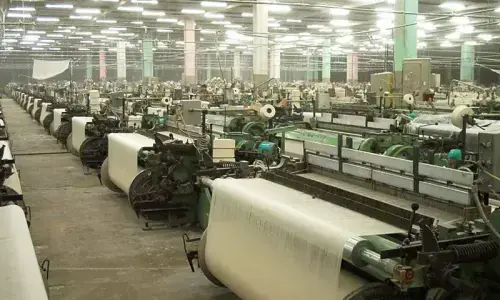
Around 400 members of the All Pakistan Textile Mills Association (Aptma) will keep their factories closed to protest against the high cost of inputs including energy and delay in the announcement of an incentives package.
In a hurriedly called press conference, Aptma Central Chairman Tariq Saud urged the government to ensure a level-playing field with regional countries and henceforth stop increasing tariffs of utilities.
Presently, he said, around 20 to 25 per cent industry capacity was closed and many more units were operating well below capacity.
Saud said that even the local market share was being captured by cheap textile and clothing products from India and other regional countries.
He said that duty on import of yarn is only 5 per cent against 28pc in India. Last year around 16,000 tonnes of yarn was imported from India. The Aptma chief urged to impose 25pc Regulatory Duty (R/D) on yarn imports.
Due to lack of support, he said, Pakistan’s textile export share in the global market has decreased from 2.2pc to 1.8pc during 2006-13, whereas Bangladesh’s rose to 3.3pc from 1.9pc, China’s to 35pc from 27pc and India’s from 3.4pc to 4.7pc.
Yasin Siddiq, former chairman of All Pakistan Textile Mills Association, said that if the situation persists, the country would be out of the list of textile goods exporting countries.
He said due to levy of gas infrastructure development cess, gas tariff has been increased by 23pc.
The cost of gas has increased to $6.7 million British thermal units (mmBtu) as compared to $4.2 mmBtu in India, $3.1 mmBtu in Bangladesh and $4.2 mmBtu in Vietnam.
Similarly, Yasin said, the average electricity tariff in the region is between 6 and 9 cents whereas in Pakistan it is Rs15, or 14.5 cents, per unit.
“The Aptma members are providing jobs to around 15 million skilled and unskilled workforce and had never sought cut in minimum wage that is higher than others in the region. However, we are demanding a level playing field to stay viable and competitive in the world market,” Yasin said.
Published in Dawn, October 13th , 2015
On a mobile phone? Get the Dawn Mobile App: Apple Store | Google Play