0
0

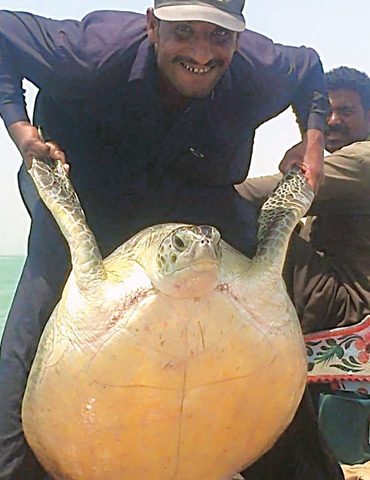
KARACHI: A large green female turtle that became entangled in fishing nets in Sonmiani Bay, Balochistan, was safely released back into the sea on Thursday.
Scientifically named Chelonia mydas, green turtles are listed as an endangered species and its subpopulation in the Mediterranean is listed as critically endangered. Their catch and trade is banned in Pakistan under the wildlife and fisheries laws.
“Fishermen were engaged in a katra net operation to catch sardines in shallow waters near Miani Hor, Sonminai Bay, when they observed that a female turtle had become entangled in the net,” said Mohammed Moazzam Khan working as technical adviser on marine fisheries with the World Wide Fund for Nature-Pakistan (WWF-P).
Though releasing a turtle was a tedious and time-consuming process, fishermen did the job remarkably; not only the turtle was saved after an effort of two hours, but they also managed to retain their catch, he said.
“This is a rare case as turtles usually don’t get trapped in the seine net (katra) operation because these nets are laid down only if no turtle is seen in shallow waters,” he explained, adding that boat captain Yasir Amin had received training from the organisation in rescuing big-size non-targeted marine animals.
The training and awareness sessions were conducted in Sonmiani Bay in collaboration with the Coalition for Appropriation of Resources and Development (Card), a local community-based organisation.
So far, 25 fishermen of Damb village have received training in a rescue operation and a number of marine animals, including whale sharks, dolphins and whales, large rays and sunfishes have been saved.
Green turtles, he said, were also included in the Appendix-I of the Convention on International Trade in Endangered Species of Wild Fauna and Flora (CITES) which meant a complete ban on their trade across the world.
“Despite these measures, thousands of marine turtles die every year. Their accidental trapping and subsequent death in fishing nets is the single most important threat to their population.
“The second is the increasing number of unwanted animals, feral dogs, crows and kites, at and around their nesting grounds. In the context of Karachi, however, construction on and near their nesting grounds have discouraged their breeding,” he explained.
Senior director-biodiversity at WWF-P Rab Nawaz said: “Pakistan’s coastal waters are important nesting grounds for green turtles, which need to be preserved. These areas included Sandspit and Cape Monz in Sindh and Ormara, Taq, Astola Island and Daran (Jiwani) in Balochistan.”
Given the importance of marine turtles in ecology and threats to their life, WWF-Pakistan, he said, had initiated programmes to monitor turtle population, study the impact of climate change on their breeding and reduce mortality in fishing operations.
“Under an awareness-raising programme started in 2012 for fishermen mostly engaged in tuna gillnet fishing operations, about 30,000 marine turtles have been saved so far that used to get trap in nets and die,” he said.
The programme was later extended to coastal areas as small-scale fishing operations in shallow waters had been found to be another threat to turtles especially female turtles. About 200 fishermen engaged in fishing in the coastal areas had been trained so far in rescue operation, he added.
According to the National Geographic website, green turtles weighing up to 317.5kg are among the largest sea turtles in the world. It inhabits tropical and subtropical coastal waters around the world and has been observed clambering onto land to sunbathe. Green turtles, like other sea turtles, undertake lengthy migrations from feeding sites to nesting grounds, normally on sandy beaches.
It is named not for the colour of its shell, which is normally brown or olive depending on its habitat, but for the greenish colour of its skin.
Published in Dawn October 2nd, 2015
On a mobile phone? Get the Dawn Mobile App: Apple Store | Google Play