40
40

LAHORE: Punjab Chief Minister Shahbaz Sharif has criticised what he termed his ‘media trial’ over the Quaid-i-Azam Solar Park and at the same time made public the so-called ‘cold war’ between his government and the Ministry of Water and Power.
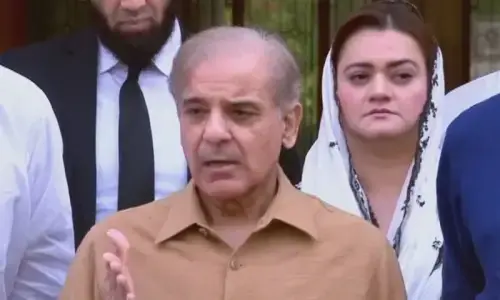
Addressing a press conference here on Wednesday on the solar park, he claimed that it was a cost-effective and efficient project to offer electricity to consumers at the lowest possible tariff because of his personal efforts. But the Nandipur project, which has sparked a lot of controversy, also surfaced at the press talk.
Also read: World's largest solar park to light up Pakistan's future
Mr Sharif sarcastically mentioned more than once the response of “his friend (Minister for Water and Power Khawaja Asif)” to a TV anchor that there “is a difference between building roads, metro bus routes and power plants”, implying that one could press for time in construction of roads but a power project had a mandatory construction process which could not be compressed for political advantage.
It appeared that the chief minister had taken the comments personally because his government had taken over construction of the Nandipur project, missed deadlines repeatedly and suffered cost over-runs.
The water and power minister as well as his ministry have been reluctant to publicly “defend the project which was inaugurated by the prime minister prematurely and has not been able to generate power ever since, drawing huge media and political flak” because they think that the Punjab chief minister, and not the federation, should be credited or blamed for it.
Accompanied by the provincial energy secretary, Mr Sharif said he had kept the solar project transparent and brought its cost lower than the lowest bid. The project was producing 17 to 19 per cent average energy like anywhere in the world, he said.
He refuted media reports that the project was generating only 10 or 11 megawatts per day and asserted that it was producing 17 to 19 megawatts. He rebutted another claim that the project cost was Rs18 billion and said it stood at Rs13.5bn.
The chief minister said his government had engaged German consultants to prepare the project’s feasibility report and in light of their recommendations issued a tender and got bids ranging between $2 million and $1.51m per megawatt.
He said the rules of Public Procurement Regulatory Authority permitted awarding a contract to the lowest bidder right away, but he negotiated with the bidder and brought the rate to $1.31m per megawatt.
Because of this effort, he said, the National Electric Power Regulatory Authority decreased its tariff from 16.3 cents to 14.1 cents. Nepra further reduced the tariff to 13.9 cents. During the same period, India installed a solar power project at the rate of $1.5m per megawatt, he said.
He said all documents relating to the project were available on websites of the energy department and solar park.
The chief minister said the prime minister had taken notice of the failure of the Nandipur project and set up a committee to look into its affairs.
He himself, he added, had called upon the National Accountability Bureau to investigate the matter and fix responsibility.
Although the Supreme Court had taken notice of the dumping of Nandipur project’s equipment at the Karachi Port where it lay rusting for three years, the prime minister ordered its audit, the chief minister said.
Power Minister Khawaja Asif will address a news conference on the project on Thursday.
Published in Dawn, September 10th, 2015
On a mobile phone? Get the Dawn Mobile App: Apple Store | Google Play