0
0

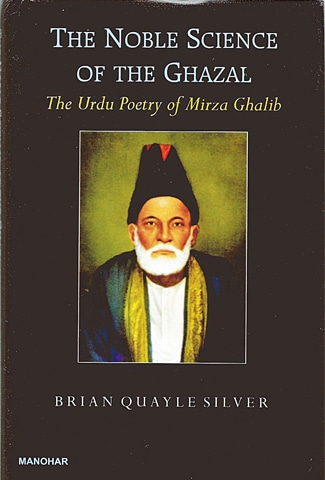 |
DR Brian Quayle Silver has come up with an interesting book titled The Noble Science of the Ghazal: the Urdu Poetry of Mirza Ghalib. But before we discuss his views on Ghalib and ghazal as expressed in the book, let us have a look at an account of Dr Brian Q. Silver’s achievements that reads like a fictionalised biography, but, believe me, it is all based on facts:
Brian Q. Silver, an American by nationality, is an educator, musician, ethnomusicologist, broadcast journalist, research scholar and critic. He has served as associate professor of Urdu and Indo-Muslim Studies at Harvard University and chief of Voice of America’s (VOA) Urdu Service, aside from holding other important positions.
Born on Sept 8, 1942, in Denver, Colorado, Brian Q. Silver completed his postgraduate studies from London University’s School of Oriental and African Studies in 1970. He did his doctorate in 1980 from University of Chicago under the supervision of Prof C.M. Naim. Dr Silver served at the University of Minnesota as assistant professor of Urdu for about four years before joining the Harvard. He also taught music at the University of Virginia. Silver served as the chief of VOA’s Urdu service from 1986 to 2007.
Since he is an ethnomusicologist as well, Silver worked for VOA as ethnomusicologist and world music curator. He is known also for his performance on sitar, the much-loved musical instrument of South Asian classical music, and has performed in concerts and music festivals in Pakistan, India, China, England, Egypt, USA, Canada and Peru, to name but a few countries. He has contributed articles and research papers on Urdu literature and South Asian music to numerous publications. In addition, he has been member of many professional, educational, welfare and music associations and organisations. For his dedicated work in different fields, Dr Silver has won many awards.
Dr Silver has always been interested in Ghlaib’s poetry and the genre of ghazal, as is evident from his early literary works such as Bibliography of English sources on Ghalib (1969) and Nuclear structure and poetic connotation in the Urdu Divan of Mirza Ghalib (1980).
The book under review, recently published by Delhi’s Manohar Publishers, has a foreword by renowned Indian scholar and critic Shamsur Rahman Faruqi. Faruqi is respected as a connoisseur of poetics and literary genres, especially ghazal and classical Urdu poetry.
In his foreword, he has emphasised that though all modern critics of Ghalib, Including Brian Silver, are “children of Hali” — the author of Yadgar-e-Ghalib, the first book on Ghalib’s life and art — modern authors like Silver have made a radical departure from Hali. This departure is made in recognising that foreign cultures should be approached on their own terms. It is ironical, writes Faruqi, that “Urdu had to wait for western scholars like [Alessandro] Bausani and Silver before it could know that its literature had the right to be read in its own idiom”.
Many have criticised ghazal, and especially Urdu’s classical ghazal, for its themes, diction and imagery that were, generally, very limited. But in the book at the very outset, Brian Silver establishes the significance of ghazal by saying that “many civilisations have created in poetry their most eloquent expression of a cultural identity; such is the case with Indo-Muslim civilisation”. He feels that “without an understanding of Urdu ghazal, any inquiry into Indo-Muslim culture will necessarily be incomplete”, because ghazal is the “quintessential expression of Urdu cultural sensibility”.
Dr Silver has definitely contributed towards the study of Urdu poetry and Urdu ghazal. He has brought with him a new perspective, but at the same time he shows respect for Urdu poetry’s idiom, theme, sensibility and cultural background in its own right. He has submitted in the intro to the book that his contribution consists of: examining “the uniquely dynamic structure of the ghazal, as exemplified in the Urdu Divan of Ghalib” and exploring “the full range of connotations” in Ghalib’s ghazals to explicate “the role that diction and imagery play in the highly compressive structure of individual couplets”.
One has to admit that indeed Dr Silver’s contribution has been invaluable and it has helped us to have a better understanding of Urdu’s classical poetry and its cultural backdrop vis-a-vis Ghalib’s ghazal.
The book has six chapters. These chapters expound the concept of a dynamic nuclear structure of ghazal; the relation of ghazal’s words, motifs and images to each other (Silver stresses that Ghalib’s diction and imagery must not be seen in isolation); the connotative analysis of words such as ‘ishq’ (love or passion) in Ghalib’s couplets; the connotative analysis of words such as ‘raqeeb’ (rival) in Ghalib’s couplets; the study of most important spatial centres in Ghalib’s couplets, such as ‘koo-e-yaar’(the beloved’s lane); and a conclusive analysis of connotative network and nuclear structure of Ghalib’s most famous ghazals.
One feels that our research scholars, university teachers and especially the research students studying for their doctoral dissertation must study this book. It will enable them to see how an analytical semantic study of a classical poetical genre is juxtaposed with the cultural peculiarities of a language and how meaningful conclusions are drawn.
Published in Dawn, June 15th, 2015
On a mobile phone? Get the Dawn Mobile App: Apple Store | Google Play