At 36 per cent, Khyber Pakhtunkhwa (KP) has the highest poverty prevalence ratio among all the federating units. This is according to the data of the provincial government itself. Yet, ground realities present a complex scenario in which all the urban centres — from Peshawar to Chitral — are in urgent need of major infrastructure improvement as roads need to be widened up to accommodate the growing vehicular traffic.
Likewise, agriculture land is being lost to a growing number of private townships and societies. Concrete structures housing educational institutions are cropping up in cities and their sprawling suburbs. Even new cultural trends are taking roots as more and more wedding halls are coming up. These are clear signs of more money; not less. Confusing?
“These are important indictors to judge improvements in household incomes, but the actual economic prosperity cannot be analysed without assessing the social indicators,” said an economist working for the provincial government.
Requesting anonymity, he said the province, indeed, has the highest poverty prevalence ratio in the country. Curbing infant mortality, for instance, remains a daunting task. Then there is the issue of female literacy, and the health sector also needs major investments to achieve universal health coverage, he said.
People belonging to different income groups did not appear to be too impressed by the recent improvements recorded in the economic indicators at the federal level.
 |
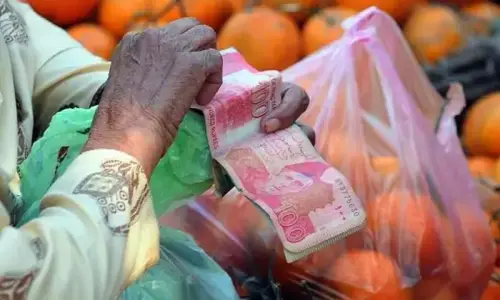
| Many labourers in KP have lost jobs because of the closure of industrial units in the recent past. —AP/File |
Mohammad Ishaq, a Peshawar-based industrialist, said household income in KP had recorded improvement only because a majority of the households had more than one income earners. “Now six people of a household earn to feed a family of 15,” he said.
The government economist said the decline in the rate of inflation, improvement in GDP growth rate, and the improved forex reserves could not trickle down to the grassroots because they had been achieved only because of financial paperwork. “These figures are not the result of true growth in sectors like industry, agriculture etc. That is why people won’t benefit much,” he said.
Ishaq concurred, pointing out that the provincial industrial sector had underwent new lows in the past two years. “We have lost a few food related factories to Afghanistan as the investors shifted their ventures across the border,” he said, adding that the prosperity levels seen in Peshawar were largely because of Afghans living in the posh localities of the provincial capital.
He said quite a few labourers had lost jobs because of the closure of industrial units in the recent past.
The economist agreed. “Thousands of students graduate from universities and colleges in Khyber Pakhtunkhwa every year. See, how many of them get jobs,” he said.
Published in Dawn March 22nd , 2015