News of Zulfikar Ali Bhutto’s hanging did not break when it happened, since the execution took place at an odd hour. Only one newspaper managed to cover the news in the morning, but some nine hours after the hanging, a press note was issued by the Interior Ministry to officially notify the news of the hanging and burial.
The text of the press note read: “Following [Bhutto’s] conviction by the Lahore High Court in the Nawab Mohammad Ahmad murder case, and subsequent rejection of his appeal by the Supreme Court of Pakistan, Mr Zulfikar Ali Bhutto was hanged to death at 2 o’clock this morning in the Rawalpindi District Jail, Rawalpindi. Earlier mercy petitions filed on his behalf were rejected by the President of Pakistan after they had been processed in accordance with the normal procedure.
The dead body was flown in a special aircraft from Rawalpindi and handed over to the elders of the family who buried him, after Namaz-i-Janaza, in the ancestral graveyard at Garhi Khuda Bux near Naudero, Larkana at 10.30 am in accordance with the wishes of the family. The funeral was attended by relatives, including his two uncles, Nawab Nabi Bux Bhutto, his first wife Shirin Amir Begum, friends and residents of the area.”
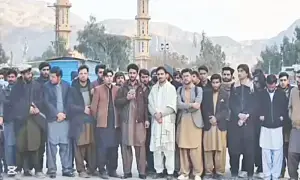
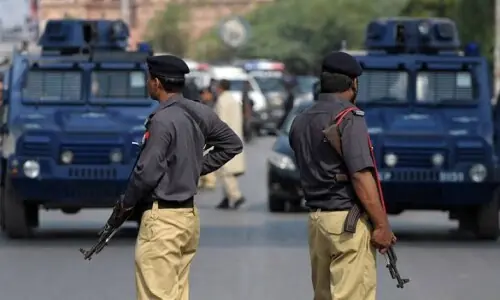
When the news became public, there were no immediate reports of any agitation in Sindh. Karachi opened as per routine, and so did Hyderabad and the other cities of Sindh. Thousands of people gathered in various city centres and offered funeral prayers in absentia. In Larkana, many PPP leaders also joined the peoples’ mourning rituals and funerals. But towns and villages in the interior of Sindh wore a deserted look. Police contingents patrolled highways and some towns in Sindh.
Sporadic riots reported in urban centres as world leaders lament Bhutto’s execution
In Punjab, the Lahore police was left astounded as angry protesters took over main roads of the provincial capital. On the Mall and Lower Mall, female protesters also staged rallies. For almost two hours, a volatile situation prevailed in Lahore, as Bhutto supporters attacked the Lahore Commissioner’s office and torched buses as well as government and private offices. Some bank branches also suffered damage, as protesters pelted them with stones. Damage was also caused to Wapda and ADBP offices; the offices of the gas utility were also set ablaze but the fire was doused before much loss was incurred.
The next day, many parts of Karachi were left paralysed after protestors resorted to arson and hurling bricks at governmental and private property. A public bus, a car, two banks and a regional office of the Taxation Department were all damaged. The situation led to the police resorting to baton-charging and tear-gassing; some 153 ‘rioters’ were also arrested under penal laws and martial law regulations. At 70-Clifton, Bhutto’s Karachi residence, another funeral-in-absentia was held where a large number of people assembled to condole and condemn Bhutto’s execution.
Amidst the mayhem, General Ziaul Haq was interviewed by British Television on the evening of April 5. The General steadfastly argued that he felt he had done the right job. “I have a very strong conviction and feeling that I have done the right thing, and done what is in the interest of Pakistan,” he said, during his telephonic interview.
Answering a question about why he did not grant clemency to the deposed prime minister despite global appeals to spare Bhutto, Gen Zia said: “I am of the opinion that the higher you go, the harder you fall. An ex-prime minister, who is supposed to safeguard the life, property and respect of the common individual ... once he indulges in criminal acts, I do not see any justification of the chief executive using his prerogative of clemency.”
Meanwhile, many types of reactions emerged from the comity of nations in the wake of the hanging. The United States made no specific reaction, but State Department spokesperson Hodding Carter said that President Jimmy Carter had been in touch with Gen Zia for the past few days, and that he had appealed for clemency “purely on humanitarian grounds.”
When reminded that Bhutto himself did not appeal for clemency, because he knew that at best it would have resulted in commuting his death sentence into life imprisonment, Carter said that was Bhutto’s wish.
Likewise, United Kingdom Prime Minister James Callaghan regretted the hanging, arguing that despite the fact that the UK respected Pakistani law, he deeply regretted that the death penalty had been invoked. Callaghan had sent three clemency appeals to Gen Zia. French Prime Minister Giscard d’Estaing also expressed his deep distress over Bhutto’s execution of Bhutto.
Closer to home, Indian Prime Minister Morarji Desai had refused to appeal for clemency, saying that this issue was Pakistan’s internal matter, in which India did not want to interfere. But after the execution, Indira Gandhi issued a statement condemning the hanging, and said that Bhutto had become a victim of a conspiracy.
Published in Dawn, Sunday Magazine, February 8th, 2015
On a mobile phone? Get the Dawn Mobile App: Apple Store | Google Play