2
2

KARACHI: “Freedom of expression does not exist in a state of isolation,” said blogger, activist and lawyer Jibran Nasir, who went on to lament lack of a united front in Pakistani media in general when reporting on issues.
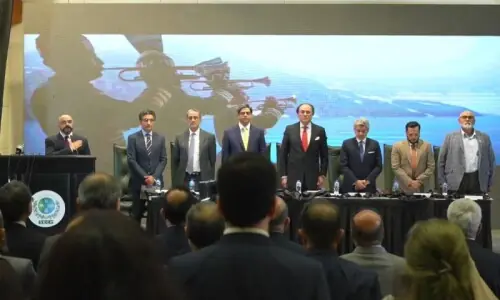
He was speaking at an event held at a local hotel to mark 50 years of youth journalism in Pakistan in the context of the Pakistan Students’ Observer, an independent, fortnightly students’ newspaper, published (1964-66) at the University of Karachi.
A group of like-minded students vied to “publish an independent students’ newspaper that was not campus-based or institutionally controlled.”
The intent behind the newspaper was to provide students of the university a platform to report their views, particularly about “freedom of expression, accountability and education governance”.
Former editors of the newspaper Javed Jabbar, Senator Khawaja Qutubuddin and Tariq Saeed accompanied a panel comprising distinguished names from the media, both mainstream and social, who commented on the evolution of journalism in the country and emphasised in particular the importance of the role of social media.
With particular reference to activism in the digital media today and the growth of citizens’ journalism, Nasir spoke at length about how quality of the content must not be compromised in this increasingly dynamic media.
Giving example of Twitter, Nasir commented on how news had become easy to disseminate as it had become bite-sized and though there were many critics of this reductionist concept, it did serve a greater purpose.
This is particularly important as many news agencies and media houses do not wish to tread a path that might incur the wrath of the powers that be.
Subjected to heavy editing when hosting a show on television, Nasir insisted that media houses should realise that if they “assume they have the licence to comment on society, they should accept the risk of being involved too”.
Journalist and human rights and gender activist Farahnaz Zahidi also insisted on the importance of micro-blogging which provided socially conscious individuals with a space to express their creative selves. The social media was providing this platform without any discrimination, she said.
Taking inspiration from her career, Zahidi recalled the incident of how her report on rigging in the 2013 elections attracted widespread threats and put the media house that she worked for under pressure.
To her the social media has allowed writers and journalists to “portray facts in a more creative way” which is not necessarily a bad thing as it does attract readers.
Working on minority rights and freedom from censorship, award-winning blogger Sana Saleem asserted the importance of mixing new media tools with those of mainstream media as “both are not very different”. This, according to her, will allow greater access to readers as well as to media houses.
Saleem has written extensively on social issues which the mainstream media has shied away from. Her experiences tell her that this medium of expression allows news information to be followed up and helps in establishing a reciprocal relationship with regards to communication between readers and distributors.
“We see a revolutionary change in how the role of gatekeepers has, if not entirely finished, then certainly diminished,” said Jahanzeb Haque, researcher and editor at Dawn.com who took the debate forward.
Citing the example of the anti-Malala narrative, he elaborated how the internet was being used as a free publishing tool to spread lies, fabrications and allowing facts to mesh into fiction.
Referring to Nasir’s insistence on media houses taking risks when reporting, Haque contended that managing control by editors was important as it was a process of minimising risks in the long run. This was however absent in the social media and which was why its dangers were manifold, he said.
Questioning the prevalent definition of what being a journalist entailed, Haque also insisted that certain principles and regulations that were part of media houses caused a certain standard to be maintained. This was why most self-proclaimed journalist bloggers were in reality mere circulators of information, he added.
The open discussion and exchange of views, though thoroughly enlightening, were unable to reach a larger audience due to limited attendance. Such spirited debates that questions prevalent trends of thought within society must be encouraged and held on a bigger scale to benefit a larger diverse group.
Published in Dawn, November 22th, 2014