IN the long time that Imran Khan has spent opposing the PML-N government, he has made innumerable allegations.
Many of those allegations have been worthless and forgotten quickly enough, but some have been worth pausing over to understand their implications and possible genuineness.
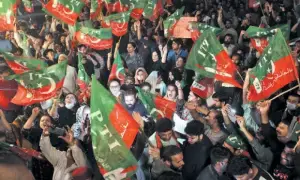
One of the latter type of allegations was levelled by the PTI chief at the Jhelum rally on Sunday: the Intelligence Bureau has spent nearly Rs3bn, according to Mr Khan, to undermine the PTI rallies and to erode support among the public and in the media for the PTI’s agenda of toppling the government.
Also read: Nawaz paid IB Rs270 crore to sabotage protests: Imran
While Mr Khan offered no evidence to support his allegation, the historical, and even ongoing, role of the IB is questionable enough, and puts the onus on the government to demonstrate that the IB is run professionally, focused on building its counterterrorism capabilities and is not being used for political purposes.
Instead of drawing on history — suffice to say the IB has been a poorer cousin of the ISI and used by civilian governments to keep tabs on political rivals and to advance governments’ political aims — consider what the PML-N government promised when it came to power last year.
After discovering that the IB had suffered years of neglect, especially during the Musharraf era when military-run intelligence agencies were allowed to run amok, Prime Minister Nawaz Sharif vowed to reinvigorate the IB and to give it the resources needed to make it the premier intelligence counterpart to civilian-run law-enforcement agencies in the provinces and at the centre.
At first, the IB, led by an untarnished career officer, Aftab Sultan, seemed to do some good work, especially in connection with the Karachi operation authorised by the PML-N last year.
Quickly enough, however, familiar allegations began to be levelled: the IB had lost its way; reforms had stalled; resources promised were not allocated or released; and, most damagingly, the IB had begun to take renewed interest in phone-tappings and the likes of political rivals of the PML-N and even members of the journalist community.
Mr Sultan was then retained on contract earlier this year after reaching the retirement age and while his personal reputation was still fairly unblemished, the extension was an early sign that the PML-N was willing to bend the rules for or accommodate public officials loyal to the prime minister.
Through it all, the IB continued to play a distant role as compared to the military-run agencies in the fight against militancy.
Part of the problem surely is the eternal civil-military imbalance and the deterioration of civilian-run institutions across the board.
But if reforms are a distant prospect and a professional turnaround of the IB unrealistic in the present milieu, at least the IB could be kept away from nakedly political agendas like dealing with the PTI challenge and shoring up support for the PML-N in the media.
Published in Dawn, November 18th , 2014