PARIS: A jab to protect children against polio that fell out of favour in the 1960s should be given a frontline role to help stamp out the disease, doctors reported in The Lancet on Friday.
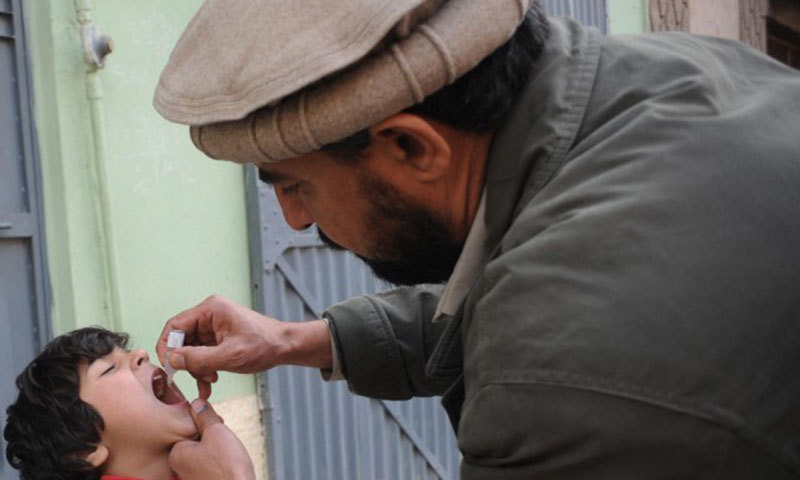
The injection can provide better and long-lasting protection against the polio virus when used to supplement oral vaccine, which replaced it in most countries, they said.
Oral polio vaccine (OPV) protects individuals against contracting the disease, but they can still be infected by the virus. It replicates in the gut and can then be passed to others through faecal-contaminated water, thus imperilling unvaccinated children.
Scientists at Imperial College London and the Christian Medical College in Vellore, in southern India's Tamil Nadu state, investigated whether the old-fashioned vaccine still had a part to play.
Their study involved 450 children from a poor urban area of Vellore, all of whom had received the oral vaccine as part of a standard innoculation programme.
Half of the children were then given a dose of the injected vaccine, which contains an inactivated virus, and the other half given nothing.
A month later, the children were given a dose of live oral vaccine, whose formula includes a tiny amount of live polio virus, the goal being to safely simulate re-infection.
A week later, their stools were tested to see if the polio virus was present — specifically the two strains of the virus, serotypes 1 and 3, which are resisting eradication.
Among children who had received the injected vaccine, there were 38 percent fewer who had traces of serotype 1, and 70 percent fewer with serotype 3, compared to those who did not get the jab.
“Because IPV (injected polio vaccine) is injected into the arm, rather than taken orally, it's been assumed it doesn't provide much protection in the gut and so would be less effective at preventing faecal transmission than OPV," said Jacob John of the Christian Medical College.
“However, we found that where the children already had a level of immunity due to OPV, the injected vaccine actually boosted their gut immunity,” he said in a press release.
He added: “In the 1960s there was extensive rivalry between the scientists who developed the two vaccines, with OPV eventually becoming the most popular.
“But it looks as if the strongest immunity can be achieved through a combination of the two.“
Tried and trusted
Also called the inactivated polio vaccine or the “Salk vaccine,” after its inventor, Jonas Salk, who developed it in 1955, the jab has long been considered an astonishingly safe and effective weapon against polio.
It is still used in dozens of countries, but in more than 120 others, oral vaccine is the exclusive choice, as it is cheaper, easier and quicker to administer.
The new findings add support to guidelines issued in February by the UN's World Health Organization (WHO).
The agency recommended that all children receive at least one dose of injected vaccine in countries that solely use OPV, in order to broaden the attack on all serotypes of the virus.
Polio, a crippling and potentially fatal disease that mainly affects children under the age of five, has taken a beating from a quarter-century vaccination effort.
In 1988, the disease was endemic in 125 countries, and 350,000 cases were recorded worldwide, according to the WHO.
Today, the virus is considered endemic in only three countries — Afghanistan, Nigeria and Pakistan.
The refugee crisis in Syria is considered another potential source of infection, as the vaccination programme there has been disrupted by war.
Health watchdogs are worried for unvaccinated children in those countries and in neighbouring countries where the vaccination guard may have slipped.
In May, the WHO declared that polio had returned as a “public health emergency” after three cases of cross-border transmission of polio were detected between January and April — from Pakistan to Afghanistan, Syria to Iraq and Cameroon to Equatorial Guinea.